
Panscopus torpidus
Buchanan, L.L., 1927
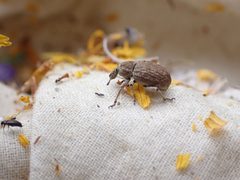
Panscopus torpidus is a weevil in the Curculionidae, Brachycerinae. It belongs to a of small to medium-sized weevils associated with coniferous forests in western North America. The species name 'torpidus' (meaning sluggish or inactive) may reflect behavioral traits or was applied descriptively by early taxonomists. It is among the less commonly encountered species in its genus, with few documented observations.
Pronunciation
How to pronounce Panscopus torpidus: /ˈpanskəpəs ˈtɔrpɪdəs/
These audio files are automatically generated. While they are not always 100% accurate, they are a good starting point.
Identification
Members of Panscopus can be distinguished from other Brachycerinae by their compact body form, short broad rostrum, and with a loose club. -level identification within Panscopus requires examination of genitalia and other fine structural characters; P. torpidus specifically is distinguished by male genitalic as described by Buchanan (1927). External characters alone are generally insufficient for reliable identification to species.
Images
Habitat
Associated with coniferous forest in montane and subalpine regions of western North America.
Distribution
Documented from western Canada (Alberta, British Columbia) and the northwestern United States (Idaho: Bonner County, Boundary County; Washington: Chelan County).
Similar Taxa
- Panscopus squamosusOverlapping distribution in western North America; distinguished by differences in male genitalia and elytral scaling patterns.
- Panscopus costatusSimilar compact body form; requires genitalic dissection for definitive separation.
- Stereocorynes spp.Formerly placed in this ; now separated based on rostral and antennal characters, but may be confused in older literature.
More Details
Taxonomic History
Originally described as Stereocorynes torpidus by LeConte in 1857, transferred to Panscopus by Buchanan in 1927. The Panscopus was revised by O'Brien (1989), who clarified boundaries using male genitalia.
Data Deficiency
The is represented by only 9 observations in iNaturalist and appears infrequently in collections, suggesting it may be genuinely rare, cryptic, or restricted to specific microhabitats that are infrequently sampled.