
Pseudocneorhinus
Roelofs, 1873
broad-nosed weevils
Species Guides
2- Pseudocneorhinus bifasciatus(twobanded Japanese weevil)
- Pseudocneorhinus obesus
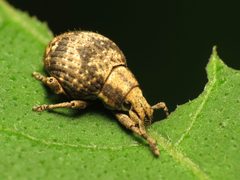
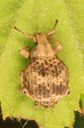
Pseudocneorhinus is a of broad-nosed weevils in the Curculionidae, containing approximately 11 described . The genus is native to East Asia, with several species recorded from Japan, the Korean Peninsula, and the Russian Far East. At least one species, P. bifasciatus (twobanded Japanese weevil), has become established as an pest in North America, where it damages ornamental and landscape plantings. The genus belongs to the tribe Trachyphloeini within the Entiminae.
Pronunciation
How to pronounce Pseudocneorhinus: /ˌsjuːdoʊˈkniːoʊˌraɪnəs/
These audio files are automatically generated. While they are not always 100% accurate, they are a good starting point.
Images
Distribution
Native to East Asia: Japan (type locality for multiple including P. bifasciatus, P. obesus, P. setosus, P. minimus, P. adamsi), Korean Peninsula (P. soheuksandoensis described from Soheuksan Island, South Korea), and Russian Far East (Primorskii Krai and Khabarovskii Krai). Introduced to North America: United States (first recorded 1914 near Philadelphia, Pennsylvania; now established in northeastern, midwestern, and southeastern states including Vermont, North Carolina, Georgia, South Carolina, Alabama, and Florida).
Human Relevance
P. bifasciatus is recognized as an important pest of landscape plantings in the northeastern and midwestern United States, with a range exceeding 100 plant . The species spreads via movement of infested nursery stock. Other species in the have no documented economic impact.
More Details
Taxonomic note
The was established by Roelofs in 1873. Some have been historically placed in other genera; for example, P. bifasciatus was previously treated under Callirhopalus (subgenus Pseudocneorhinus).
Reproductive biology
P. bifasciatus has been reported to reproduce parthenogenetically, though this trait has not been confirmed for other in the .
Sources and further reading
- BugGuide
- Wikipedia
- GBIF taxonomy match
- iNaturalist taxon
- NCBI Taxonomy
- Catalogue of Life
- Notes on the Biology and Control of Pseudocneorhinus bifasciatus1
- Twobandad Japanese Weevil, Pseudocneorhinus bifasciatus Roelofs (Insecta: Coleoptera: Curculionidae)
- First records of Pseudocneorhinus adamsi Roelofs, 1879 and P. squameus Morimoto, 2015 (Coleoptera, Curculionidae) from the Russian Far East with notes on Pseudocneorhinus Roelofs, 1873 species distribution
- Distribution of an Invasive Weevil, Pseudocneorhinus bifasciatus Roelofs, in the Southeastern United States
- Descriptions of the Larva and Pupa of Callirhopalus (subg. Pseudocneorhinus)bifasciatus, the Twobanded Japanese Weevil, with New Host Plant Records1