
Pseudocneorhinus bifasciatus
Roelofs, 1880
twobanded Japanese weevil, two-banded Japanese weevil
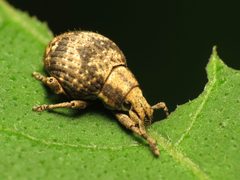
Pseudocneorhinus bifasciatus is an broad-nosed weevil native to Japan that has established in the United States. First detected near Philadelphia in 1914, it is believed to have arrived via infested nursery stock. The has since spread throughout the northeastern, midwestern, and southeastern United States, with documented presence in at least 11 states. It is recognized as a significant pest of ornamental and landscape plantings due to its broad range.
Pronunciation
How to pronounce Pseudocneorhinus bifasciatus: /ˌsjuːdoʊkniːˈɔraɪnəs baɪˌfæsɪˈeɪtəs/
These audio files are automatically generated. While they are not always 100% accurate, they are a good starting point.
Identification
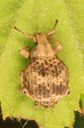
A broad-nosed weevil with two distinct pale bands across the , giving rise to its . are small weevils with the characteristic rostrum of Curculionidae. Larvae and pupae have been described in scientific literature, with larvae being soil-dwelling and C-shaped, typical of weevil immatures.
Images
Habitat
Associated with landscape plantings, nursery stock, and ornamental plantings. Larval stages occur in soil around plant roots.
Distribution
Native to Japan. Introduced to the United States: first collected 1914 near Philadelphia, Pennsylvania. Established in northeastern and midwestern United States. Documented in southeastern states: Alabama (3 counties), Georgia (12 counties), North Carolina (16 counties), South Carolina (19 counties), with first collections in 1955 (North Carolina), 1956 (Georgia), 1966 (South Carolina), and 1970 (Alabama). Also recorded in Florida (2005), Connecticut, and District of Columbia. Distribution continues to expand due to movement of nursery stock.
Diet
feed on foliage of plants. Larvae feed on roots.
Host Associations
- over 100 plant species - broad range including numerous ornamental and landscape plants; specific host plant records documented in scientific literature but not enumerated in available sources
Life Cycle
Complete with , larval, pupal, and stages. Larvae are soil-dwelling and feed on roots. occurs in soil. Larval and pupal stages have been formally described in taxonomic literature.
Ecological Role
Pest of ornamental plantings and landscape vegetation. Soil-dwelling larvae contribute to below-ground herbivory on plant roots.
Human Relevance
Recognized as an important pest of landscape plantings in the northeastern and midwestern United States. Not yet a major pest in southeastern states, but range expansion is anticipated due to nursery stock movement. Management concerns include protection of ornamental and nursery plantings.
Similar Taxa
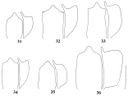
- other Pseudocneorhinus speciescongeneric weevils with similar broad-nosed ; requires examination of elytral banding patterns and genitalia for definitive identification
- other Entiminae weevilsbroad-nosed weevils share general body form; distinguished by specific elytral pattern of two pale bands
More Details
Reproduction
in the United States are parthenogenetic, with occurring without males. This reproductive mode facilitates establishment and spread by single females.
Invasion History
The exemplifies classic nursery stock-mediated invasion, with initial establishment near major port cities (Philadelphia) followed by gradual range expansion correlated with horticultural trade.
Sources and further reading
- BugGuide
- Wikipedia
- GBIF taxonomy match
- iNaturalist taxon
- Catalogue of Life
- Encyrtid Holdings | Entomology Research Museum
- Twobandad Japanese Weevil, Pseudocneorhinus bifasciatus Roelofs (Insecta: Coleoptera: Curculionidae)
- Distribution of an Invasive Weevil, Pseudocneorhinus bifasciatus Roelofs, in the Southeastern United States
- Descriptions of the Larva and Pupa of Callirhopalus (subg. Pseudocneorhinus)bifasciatus, the Twobanded Japanese Weevil, with New Host Plant Records1
- Notes on the Biology and Control of Pseudocneorhinus bifasciatus1