
Thecesternus
Say, 1831
bison dung weevils, bison snout beetles
Species Guides
4- Thecesternus affinis
- Thecesternus hirsutus(bison dung weevil)
- Thecesternus humeralis
- Thecesternus maculosus(bison dung weevil)
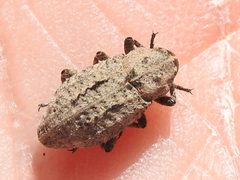
Thecesternus is a of flightless, broad-nosed weevils comprising approximately seven described . These small beetles, measuring about six millimeters in length, are known for their truncated rostrum and habit of sheltering under bison in grassland . The genus has been studied primarily through *T. hirsutus*, which was evaluated as a potential agent for the weed *Parthenium hysterophorus*.
Pronunciation
How to pronounce Thecesternus: /θɛˈsɛstərnəs/
These audio files are automatically generated. While they are not always 100% accurate, they are a good starting point.
Identification
Distinguished from other broad-nosed weevils by the extremely short rostrum. Flightless condition and further separate them from similar weevil . When disturbed, draws in , , and legs to feign death, enhancing pebble-like appearance. -level identification requires examination of specific morphological characters not detailed in available sources.
Images
Appearance
Small weevils approximately 6 mm in body length with a notably short, truncated rostrum ('nose') compared to other weevils. Body form adapted for , resembling small pebbles or debris. can be retracted when disturbed.
Habitat
Grassland and prairie , historically associated with bison ranges. shelter sought under bison , rocks, or other ground debris. Distribution tied to areas with protective cover from daytime heat and desiccation.
Distribution
North America: central, eastern, and southwestern United States; north to Alberta, Canada. Seven collectively cover this range.
Seasonality
active above ground during summer months. In at least *T. hirsutus*, adults emerge in April–May following , with some evidence of partial second in summer. Observations in Colorado (El Paso County) indicate adult presence in April.
Diet
Larvae feed externally on roots of plants, stimulating gall formation. *T. hirsutus* larvae associated with *Parthenium hysterophorus* roots. feeding habits above ground not detailed in available sources.
Host Associations
- Parthenium hysterophorus - larval plantgall-forming root feeder
Life Cycle
For *T. hirsutus*: laid in soil by females in fall, triggered by autumn rains. Larvae hatch and burrow deeper, feeding externally on roots and forming earthen protective chambers reinforced with anal secretions. Larvae mature December–February, remain until early April, then pupate. Adults emerge April–May. Partial second possible with spring oviposition. Winter spent in larval stage underground.
Behavior
and flightless. Seeks shelter under debris during day to avoid heat. Exhibits (death-feigning) when disturbed, retracting , legs, and . Highly sensitive to motion, vibration, and light, making observation difficult.
Ecological Role
Root-feeding larvae form galls on plants, potentially influencing plant . Historical association with bison suggests role in nutrient cycling in prairie . Evaluated as agent for *Parthenium hysterophorus*.
Human Relevance
Studied for potential of *Parthenium hysterophorus* (Santa Maria feverfew), an weed causing respiratory allergies, contact dermatitis, and livestock . *T. hirsutus* deemed poor control candidate. Rarely encountered by observers due to cryptic habits and activity.
Similar Taxa
- Other broad-nosed weevils (Curculionidae)Distinguished by truncated rostrum; most other weevils have elongated snouts
- Other flightless weevils specificity and bison association historically characteristic; and differ
More Details
Laboratory rearing insights
Rearing of *T. hirsutus* demonstrated to unpredictable weather patterns and climate volatility, suggesting potential value as models for studying insect responses to global warming and extreme weather events.
Taxonomic note
established by Say in 1831. Seven described : *T. affinis*, *T. albidus*, *T. foveolatus*, *T. hirsutus*, *T. humeralis*, *T. longior*, *T. maculosus*.