
Compsus auricephalus
(Say, 1824)
golden-headed weevil
Compsus auricephalus is a broad-nosed weevil in the Curculionidae, native to the southern United States and Central America. It is the northernmost of the predominantly Neotropical Compsus and the only native representative of the genus in the USA. The species exhibits two distinct color : a typical green form with pink to coppery and legs, and a uniformly white to pale brown form. It shows considerable morphological variation across its range, including body shape, elytral apices, and pronounced sexual size dimorphism.
Pronunciation
How to pronounce Compsus auricephalus: /ˈkɔm.psus aʊˈriː.sɛ.fələs/
These audio files are automatically generated. While they are not always 100% accurate, they are a good starting point.
Identification
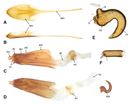
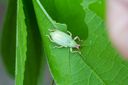
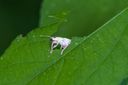
Two color exist: green body with pink/coppery and legs, or uniformly white to pale brown. Size ranges 8–15 mm with males sometimes half the size of females. Southern show more elongate body, produced and acuminate elytral apices, and strongly costate alternating interstriae. Distinguished from similar Central American by less elevated elytral intervals and male genitalia features; a related species south of Guatemala has more elevated elytral intervals.
Images
Habitat
Collected in palmetto thickets and woods, vegetation along roads, and prairies. Found at elevations from sea level to 1200 m, with most specimens collected below 100 m.
Distribution
Native to southern USA (Alabama, Arizona, Arkansas, Colorado, Florida, Georgia, Illinois, Kentucky, Louisiana, Mississippi, New Mexico, Ohio, Oklahoma, Tennessee, Texas, Utah) and Central America (Mexico, Guatemala as far south as Zacapa). Records south of Zacapa correspond to a different, undescribed species. Intercepted at ports of entry in Ontario, Canada. Northern limit: Illinois; western limit: Colorado and Arizona; eastern limit: Georgia.
Behavior
Exhibits two distinct color . Shows broad size variation with in body size. Southern display more elongate body form and produced, acuminate elytral apices.
Ecological Role
Human Relevance
Subject of taxonomic revision in 2020. Misidentification at ports of entry poses biosecurity concerns due to similarity with other potentially pestiferous Compsus .
Similar Taxa
- Compsus benoistiSimilar metallic appearance; C. benoisti has disco ball-like coloration and was featured in documentary 'The Love '
- Undescribed Compsus speciesDistributed in Rica, Honduras, Nicaragua, and Panama; matches white morph of C. auricephalus but has more elevated elytral intervals and distinct male genitalia
Sources and further reading
- BugGuide
- Wikipedia
- GBIF taxonomy match
- iNaturalist taxon
- NCBI Taxonomy
- Catalogue of Life
- Entomology on Screen: Q&A With the Directors of 'The Love Bugs'
- Variability and distribution of the golden-headed weevil Compsus auricephalus (Say) (Curculionidae: Entiminae: Eustylini)
- Figure 7 from: Girón JC, Chamorro ML (2020) Variability and distribution of the golden-headed weevil Compsus auricephalus (Say) (Curculionidae: Entiminae: Eustylini). Biodiversity Data Journal 8: e55474. https://doi.org/10.3897/BDJ.8.e55474
- Figure 2 from: Girón JC, Chamorro ML (2020) Variability and distribution of the golden-headed weevil Compsus auricephalus (Say) (Curculionidae: Entiminae: Eustylini). Biodiversity Data Journal 8: e55474. https://doi.org/10.3897/BDJ.8.e55474
- Figure 5 from: Girón JC, Chamorro ML (2020) Variability and distribution of the golden-headed weevil Compsus auricephalus (Say) (Curculionidae: Entiminae: Eustylini). Biodiversity Data Journal 8: e55474. https://doi.org/10.3897/BDJ.8.e55474
- Figure 9 from: Girón JC, Chamorro ML (2020) Variability and distribution of the golden-headed weevil Compsus auricephalus (Say) (Curculionidae: Entiminae: Eustylini). Biodiversity Data Journal 8: e55474. https://doi.org/10.3897/BDJ.8.e55474
- Figure 6 from: Girón JC, Chamorro ML (2020) Variability and distribution of the golden-headed weevil Compsus auricephalus (Say) (Curculionidae: Entiminae: Eustylini). Biodiversity Data Journal 8: e55474. https://doi.org/10.3897/BDJ.8.e55474
- Figure 1 from: Girón JC, Chamorro ML (2020) Variability and distribution of the golden-headed weevil Compsus auricephalus (Say) (Curculionidae: Entiminae: Eustylini). Biodiversity Data Journal 8: e55474. https://doi.org/10.3897/BDJ.8.e55474
- Figure 10 from: Girón JC, Chamorro ML (2020) Variability and distribution of the golden-headed weevil Compsus auricephalus (Say) (Curculionidae: Entiminae: Eustylini). Biodiversity Data Journal 8: e55474. https://doi.org/10.3897/BDJ.8.e55474
- Figure 8 from: Girón JC, Chamorro ML (2020) Variability and distribution of the golden-headed weevil Compsus auricephalus (Say) (Curculionidae: Entiminae: Eustylini). Biodiversity Data Journal 8: e55474. https://doi.org/10.3897/BDJ.8.e55474
- Figure 3 from: Girón JC, Chamorro ML (2020) Variability and distribution of the golden-headed weevil Compsus auricephalus (Say) (Curculionidae: Entiminae: Eustylini). Biodiversity Data Journal 8: e55474. https://doi.org/10.3897/BDJ.8.e55474
- Figure 4 from: Girón JC, Chamorro ML (2020) Variability and distribution of the golden-headed weevil Compsus auricephalus (Say) (Curculionidae: Entiminae: Eustylini). Biodiversity Data Journal 8: e55474. https://doi.org/10.3897/BDJ.8.e55474
- Supplementary material 1 from: Girón JC, Chamorro ML (2020) Variability and distribution of the golden-headed weevil Compsus auricephalus (Say) (Curculionidae: Entiminae: Eustylini). Biodiversity Data Journal 8: e55474. https://doi.org/10.3897/BDJ.8.e55474