
Compsus
Schönherr, 1823
Species Guides
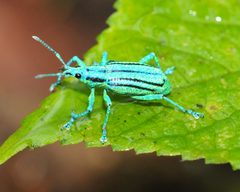
1- Compsus auricephalus(golden-headed weevil)
Compsus is a of broad-nosed weevils in the Curculionidae, comprising approximately 101 described distributed across the Americas. The genus belongs to the taxonomically challenging 'Compsus genus complex' within the tribe Eustylini, which includes related genera such as Exorides, Eustylus, and Oxyderces. Several species are economically significant as pests of citrus crops in Colombia, including C. viridivittatus and C. obliquatus. The genus was first described by Carl Johan Schönherr in 1823.

Pronunciation
How to pronounce Compsus: /ˈkɒmpsəs/
These audio files are automatically generated. While they are not always 100% accurate, they are a good starting point.
Identification
Compsus are moderate-sized broad-nosed weevils (approximately 7–12 mm) with bodies uniformly covered by of variable coloration ranging from white to metallic green, pink, and blue. Identification to species level is challenging due to overlapping morphological features with related eustyline . The 'Compsus genus complex' presents particular taxonomic difficulties, requiring examination of genitalia and other detailed morphological characters for accurate determination. A key to species was provided by Hustache in 1938 and later translated and adjusted by O'Brien and Peña.
Images
Distribution
Distributed across the Americas from the southern United States through Central America and northern South America. Records include: Argentina, Bolivia, Brazil, Colombia, Ecuador, French Guiana, Guyana, Peru, Suriname, Venezuela; Rica, Guatemala, Mexico, Nicaragua, Panama; and Caribbean islands including Guadeloupe and Jamaica. The northernmost , C. auricephalus, ranges from the southern U.S.A. (Illinois, Colorado, Arizona, Georgia) through Central America to Guatemala.
Human Relevance
Two , Compsus obliquatus and Compsus viridivittatus, are recognized as pests of Citrus in Colombia, causing economic damage to citrus orchards. Compsus viridivittatus larvae feed on roots while consume leaves, flowers, and fruits, causing leaf area reductions exceeding 50% in young trees and 20–30% in production trees. Compsus auricephalus has been documented with associations to 46 plant species in 23 . The has also been subject of research, with studies on including Trigonospila unicaldasi (Diptera: Tachinidae) and parasitoids such as Trichogramma species.
Similar Taxa
- ExoridesOverlapping morphological features; both belong to the 'Compsus complex' of Eustylini, requiring detailed examination for separation
- EustylusOverlapping morphological features; both belong to the 'Compsus complex' of Eustylini, requiring detailed examination for separation
- OxydercesOverlapping morphological features; both belong to the 'Compsus complex' of Eustylini, requiring detailed examination for separation
More Details
Taxonomic History
The was established by Carl Johan Schönherr in 1823. It belongs to the Entiminae, tribe Eustylini, and the 'Compsus genus complex'—a group of approximately 180 South American that presents significant identification challenges, particularly at ports of entry.
Collection Significance
The O'Brien weevil collection donated to Arizona State University in 2017, which included over 1 million weevil specimens, featured Compsus benoisti prominently in the documentary film 'The Love ' (2019). This collection more than doubled the size of ASU's entomological collection.
Sources and further reading
- BugGuide
- Wikipedia
- GBIF taxonomy match
- iNaturalist taxon
- NCBI Taxonomy
- Catalogue of Life
- Entomology on Screen: Q&A With the Directors of 'The Love Bugs'
- Variability and distribution of the golden-headed weevil Compsus auricephalus (Say) (Curculionidae: Entiminae: Eustylini)
- Exigencias térmicas de Trigonospila unicaldasi (DÍPTERA: TACHINIDAE), parasitoide de Compsus sp. (COLEOPTERA: CURCULIONIDAE)
- Feeding and Oviposition Behavior of Compsus Viridivittatus (Coleoptera: Curculionidae) On Species Of Citrus
- Biology and Natural Enemies of the Citrus Weevil Compsus N. Sp. (Coleoptera: Curculionidae)
- New species of the genus Trigonospila Pokorny (DIPTERA: TACHINIDAE) parasitises adult Compsus sp. schoenherr (COLEOPTERA: CURCULIONIDAE) in Colombia
- Anatomic Characteristics of a New Species of Compsus (Coleoptera: Curculionidae) a Pest of Citrus in Colombia
- Efecto parasítico de Trichogramma y del depredador Chrysoperla sobre huevos de Compsus viridivittatus, plaga de Vitis vinifera, en laboratorio
- Respuesta olfativa de Trigonospila unicaldasi (Díptera: Tachinidae) a volátiles de plantas de cítricos atacadas por Compsus viridivittatus (Coleoptera: Curculionidae) y asperjadas con polisulfuro de calcio
- Figure 2 from: Girón JC, Chamorro ML (2020) Variability and distribution of the golden-headed weevil Compsus auricephalus (Say) (Curculionidae: Entiminae: Eustylini). Biodiversity Data Journal 8: e55474. https://doi.org/10.3897/BDJ.8.e55474
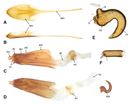
- Figure 10 from: Girón JC, Chamorro ML (2020) Variability and distribution of the golden-headed weevil Compsus auricephalus (Say) (Curculionidae: Entiminae: Eustylini). Biodiversity Data Journal 8: e55474. https://doi.org/10.3897/BDJ.8.e55474
- Figure 9 from: Girón JC, Chamorro ML (2020) Variability and distribution of the golden-headed weevil Compsus auricephalus (Say) (Curculionidae: Entiminae: Eustylini). Biodiversity Data Journal 8: e55474. https://doi.org/10.3897/BDJ.8.e55474
- Figure 1 from: Girón JC, Chamorro ML (2020) Variability and distribution of the golden-headed weevil Compsus auricephalus (Say) (Curculionidae: Entiminae: Eustylini). Biodiversity Data Journal 8: e55474. https://doi.org/10.3897/BDJ.8.e55474
- Figure 8 from: Girón JC, Chamorro ML (2020) Variability and distribution of the golden-headed weevil Compsus auricephalus (Say) (Curculionidae: Entiminae: Eustylini). Biodiversity Data Journal 8: e55474. https://doi.org/10.3897/BDJ.8.e55474
- Supplementary material 1 from: Girón JC, Chamorro ML (2020) Variability and distribution of the golden-headed weevil Compsus auricephalus (Say) (Curculionidae: Entiminae: Eustylini). Biodiversity Data Journal 8: e55474. https://doi.org/10.3897/BDJ.8.e55474
- Figure 3 from: Girón JC, Chamorro ML (2020) Variability and distribution of the golden-headed weevil Compsus auricephalus (Say) (Curculionidae: Entiminae: Eustylini). Biodiversity Data Journal 8: e55474. https://doi.org/10.3897/BDJ.8.e55474