
Cyrtepistomus castaneus
(Roelofs, 1873)
Asiatic oak weevil, Asian oak weevil
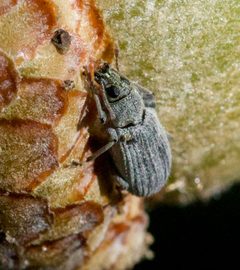
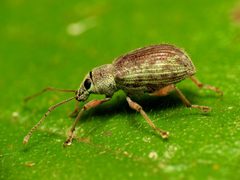
Cyrtepistomus castaneus, commonly known as the Asiatic oak weevil, is an broad-nosed weevil native to Asia that was first detected in North America in 1933. are folivores that feed on oak (Quercus) and red maple (Acer rubrum) leaves, while larvae develop in soil feeding on root hairs. The has established widespread across eastern and central North America.
Pronunciation
How to pronounce Cyrtepistomus castaneus: /ˌsɜrtɪˈpɪstəməs kæsˈtænɪəs/
These audio files are automatically generated. While they are not always 100% accurate, they are a good starting point.
Images
Habitat
Associated with deciduous forests and urban landscapes where trees occur; soil-dwelling larvae develop in root zones of host plants.
Distribution
Native to Asia; introduced to North America with first detection in 1933. Established recorded from Arkansas, California, Connecticut, District of Columbia, and Beijing (China).
Diet
Larvae feed on root hairs in soil. are defoliators of Quercus (oak) and Acer rubrum (red maple) leaves.
Host Associations
- Quercus - food plant defoliation
- Acer rubrum - food plant defoliation
Life Cycle
Larvae develop in soil feeding on root hairs. emerge to feed on foliage of trees.
Ecological Role
As an , cause measurable defoliation of native North American hardwood trees; ecological impacts on native forest remain under study.
Human Relevance
Recognized as a forestry pest due to defoliation of oak and maple trees; of concern for urban and natural forest management in invaded regions.
Sources and further reading
- BugGuide
- Wikipedia
- GBIF taxonomy match
- iNaturalist taxon
- NCBI Taxonomy
- Catalogue of Life
- Meloidae Holdings | Entomology Research Museum
- Bug Eric: City Nature Challenge 2024 Recap
- Glorious Earthworms - Buglife Blog - Buglife
- A Field Study of Host Tree Associations of an Exotic Species, the Asiatic Oak Weevil [Cyrtepistomus castaneus (Roelofs 1873), Coleoptera: Curculionidae]