
Curculio caryae
Horn, 1873
pecan weevil
Curculio caryae, the pecan weevil, is a specialized nut-feeding weevil native to North America and a major economic pest of pecan (Carya illinoinensis) and hickory (Carya ) production. emerge from soil in August and September, feed on developing nuts, and females use their elongated to drill through shells and deposit into kernels. Larvae develop inside nuts for approximately 42 days before emerging through clean, round exit holes and burrowing into soil to pupate. The typically spans two years, though approximately 10% of individuals require three years. The species has been observed to occasionally infest Persian walnut (Juglans regia).
Pronunciation
How to pronounce Curculio caryae: //kɜːrˈkjuːlioʊ ˈkɛəriˌaɪ//
These audio files are automatically generated. While they are not always 100% accurate, they are a good starting point.
Identification
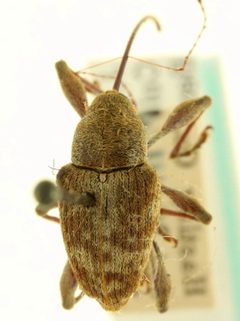
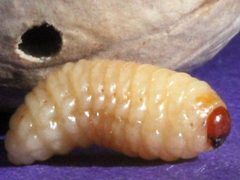
Distinguished from other Curculio by its obligate association with Carya nuts and specific morphological proportions. can be identified by the combination of medium-brown coloration and length approximately equal to body length. Larval exit holes in pecan shells are clean, round, and BB-sized—diagnostic of pecan weevil when found on fallen nuts. Monitoring using pyramid traps, wire cone traps, or circle traps placed on tree trunks can confirm adult presence.
Images
Appearance
are medium-brown beetles approximately 9.5 mm (3/8 inch) long with a of equal length to the body; mouthparts are located at the end of the proboscis. Larvae are legless, creamy-white with reddish-brown capsules, reaching up to 15 mm (3/5 inch) at full growth.
Habitat
Pecan orchards and native stands of hickory and pecan (Carya ). are found in tree during the nut development period; larvae develop within nuts. stages occur underground in soil where larvae burrow 4–12 inches deep to pupate and overwinter.
Distribution
Native to North America; present throughout most of Texas and pecan-growing regions of the United States and Canada, including Ontario and Québec. Distribution corresponds closely with commercial and native ranges of Carya illinoinensis and other Carya .
Seasonality
emerge from soil from mid-August through early September, with peak from late August through early September; emergence may be delayed by drought conditions. Adult activity continues through fall. Larvae emerge from nuts beginning in late September and continuing as late as December.
Diet
Obligate feeder on nuts of North American hickories and pecans (Carya ). feed on developing pecan nuts. Larvae feed exclusively inside nuts, consuming the kernel. Has been observed to infest Persian walnut (Juglans regia), though this is not a primary .
Host Associations
- Carya illinoinensis - primary pecan; economically most important
- Carya species - primary hickories
- Juglans regia - secondary Persian walnut; observed but not primary
Life Cycle
Complete with an extended typically requiring two years, though approximately 10% of individuals require three years. emerge from soil, feed on nuts, and oviposit into developing kernels. hatch into larvae that feed inside nuts for about 42 days. Full-grown larvae exit nuts through chewed holes, drop to ground, and burrow 4–12 inches into soil to construct where they remain 8–10 months. Most pupate and transform to adults within weeks, but adults remain in cells until the following summer. Some larvae delay for an additional year.
Behavior
are relatively sedentary, with mean movement distance less than 30 meters over 2–3 week periods, though some individuals disperse greater than 100 meters. More adults crawl to tree trunks than fly; a proportion flies directly from orchard floor into . Majority of movement occurs at dusk. Vertical distribution within canopy is generally uniform, though more individuals are captured near tree tops when flying between trees.
Ecological Role
Specialized herbivore of Carya nuts; significant pest in agroecosystems. Limited may constrain natural spread between orchards. influenced by soil conditions affecting timing.
Human Relevance
Major economic pest of pecan production, causing crop loss through feeding and oviposition that causes nut drop, and larval feeding that destroys edible kernels. are often localized and vary within orchards. Management relies on monitoring with traps and applying foliar when adults are present and nuts reach gel stage. Early harvest before larval exit can reduce infestations. Transport of infested nuts can spread weevils to uninfested areas.
Similar Taxa
- Conotrachelus nenupharplum curculio; also a curculionid nut/fruit pest with elongated rostrum, but attacks rosaceous fruits (stone and pome fruits) rather than Carya nuts, and has different associations and geographic range
- Sitona hispidulusclover root curculio; another curculionid agricultural pest, but feeds on alfalfa and clover roots rather than tree nuts, and has different and
More Details
Genome
-level assembly published in 2026; genome size approximately 2.169 Gb assembled into 13 chromosomes; BUSCO completeness 95.4%; 19,508 protein-coding genes predicted. First published genome for Curculio.
Management considerations
applications for pecan weevil control may increase by destroying natural enemies. Trunk barriers using insecticide or sticky bands may provide partial control but are ineffective if weevils fly directly into from untreated trees.
Sources and further reading
- BugGuide
- Wikipedia
- GBIF taxonomy match
- iNaturalist taxon
- NCBI Taxonomy
- Catalogue of Life
- Insects that feed on the pecan nut - AgriLife Extension Entomology
- Insects and mites that feed on leaves - AgriLife Extension Entomology
- Managing Insect and Mite Pests of Commercial Pecans in Texas - AgriLife Extension Entomology
- Bug Eric: February 2009
- Clover Root Curculio: Historic Perspectives Guide Modern Management
- Plum Curculio: New Guide Gathers IPM Recommendations for North American Fruit Pest
- Movement of adult pecan weevils Curculio caryae within pecan orchards