
Hadroplontus litura
(Fabricius, 1775)
Canada thistle stem weevil, minute seed weevil
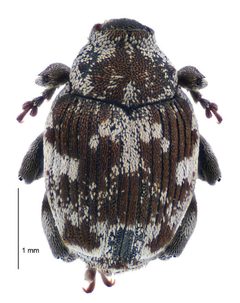
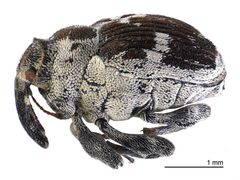
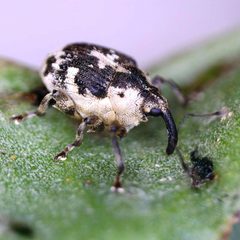
Hadroplontus litura is a stem-mining weevil in the Curculionidae, widely known as the Canada thistle stem weevil. It is an endophagous herbivore that develops within the stems of its plants. The has been investigated extensively as a agent for the weed Canada thistle (Cirsium arvense). Research indicates it can complete its on multiple Cirsium species, including five native thistle species in the upper Midwest of North America, raising concerns about non-target impacts on native flora.
Pronunciation
How to pronounce Hadroplontus litura: /hædroʊˈplɒntəs ˈlɪtjʊrə/
These audio files are automatically generated. While they are not always 100% accurate, they are a good starting point.
Identification
Formerly classified under Ceutorhynchus litura; distinguished from other seed weevils by association with Cirsium thistle and stem-mining habit. As a minute seed weevil, are small-bodied with the characteristic elongated rostrum of Curculionidae. Specific morphological diagnostic features distinguishing H. litura from congeneric are not documented in available sources.
Images
Habitat
Associated with Cirsium thistle in temperate North American . Larvae develop endophagously within plant stems. occur in habitats supporting Cirsium arvense and related thistle species.
Distribution
North America; specifically documented in the upper Midwest region of the United States and Canada (including Alberta). GBIF records indicate presence in Belgium, though status of these records requires verification. Native range not explicitly defined in available sources.
Seasonality
activity and oviposition occur in spring. Female weevils begin laying approximately 1 to 3 weeks after Cirsium arvense shoot . closely tied to plant shoot emergence, which is predicted by soil cumulative growing degree days.
Diet
Herbivorous; endophagous stem-miner feeding within Cirsium stems. Larval development occurs within plant stems.
Host Associations
- Cirsium arvense - primary Canada thistle; weed targeted for
- Cirsium species native to the upper Midwest - confirmed Five native demonstrated to support complete ; no phenological separation protects them from oviposition
Life Cycle
Complete with endophagous larval development. Larvae mine within plant stems. Can complete full on multiple Cirsium . Specific details of , larval instars, , and timing require primary source verification.
Behavior
Stem-mining feeding ; endophagous development concealed within plant tissues. Oviposition timing closely synchronized with host shoot .
Ecological Role
Herbivore and potential agent for Canada thistle. Poses demonstrated non-target risk to native Cirsium due to phenological overlap in shoot timing. No ecological separation exists between native thistles and C. arvense that would prevent H. litura attack.
Human Relevance
Investigated as a agent for Canada thistle (Cirsium arvense), a significant agricultural and rangeland weed in North America. -range studies reveal potential for non-target impacts on native thistle biodiversity, complicating its use as a biocontrol agent.
Similar Taxa
- Ceutorhynchus speciesFormerly classified in this ; morphological similarity and shared tribe (Ceutorhynchini) may cause confusion. Distinct associations and taxonomic revision separate the genera.
- Other Hadroplontus speciesCongeneric seed weevils may overlap in distribution and general ; specific identification requires examination of genitalia or molecular markers not detailed in available sources.
More Details
Taxonomic History
Reclassified from Ceutorhynchus litura to Hadroplontus litura, reflecting revised understanding of phylogenetic relationships within the Ceutorhynchini.
Biocontrol Implications
Despite -range testing showing native Cirsium are within the fundamental host range, phenological studies demonstrate all tested native species have shoots available during the oviposition window. This challenges assumptions that phenological differences might provide ecological host-range limitation.
Sources and further reading
- BugGuide
- Wikipedia
- GBIF taxonomy match
- iNaturalist taxon
- NCBI Taxonomy
- Catalogue of Life
- Spodoptera litura Archives - Entomology Today
- How Artificial Intelligence Could Make It Easier to ID Common Corn Pests
- data augmentation example - Entomology Today
- four corn pest species instars - Entomology Today
- Life History and Phenology of an Endophagous Stem-Mining Herbivore (Coleoptera: Curculionidae,Hadroplontus litura) of a Clonal Weed
- Biological control of Canada thistle (Cirsium arvense) revisited: host range of Hadroplontus litura on Cirsium species native to the Upper Midwest, USA
- Phenologies of Canada thistle (Cirsium arvense) andCirsiumspecies native to the upper Midwest: implications for the ecological host range of the biocontrol agentHadroplontus litura