
Euparius marmoreus
(Olivier, 1800)
Marbled Fungus Weevil
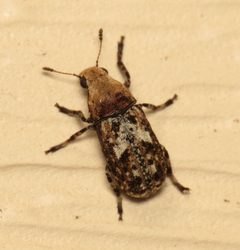
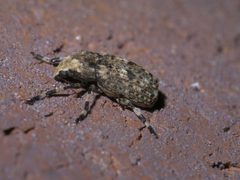
Euparius marmoreus is a fungus weevil in the Anthribidae, commonly known as the Marbled Fungus Weevil. It is found in North America, with records from Canada and the United States. The is associated with polypore fungi, which serve as its food source. It has been documented feeding on fungi in the Trametes and Megasporoporia.
Pronunciation
How to pronounce Euparius marmoreus: //juːˈpɛəriəs mɑːrˈmɔriəs//
These audio files are automatically generated. While they are not always 100% accurate, they are a good starting point.
Identification
As a member of the Anthribidae, Euparius marmoreus can be distinguished from true weevils (Curculionidae) by its straight, non-geniculate and the absence of a distinct rostrum. The specific epithet "marmoreus" (marbled) suggests a mottled or marbled color pattern on the body, though detailed diagnostic features for -level identification within Euparius require examination of specific morphological characters not detailed in available sources.
Images
Habitat
Associated with woodland and forest environments where its fungi occur. Found in proximity to decaying wood bearing polypore fungi.
Distribution
North America. Documented from Canadian provinces including Manitoba, New Brunswick, Nova Scotia, and Ontario. Present in the United States, with observations from states including Missouri and Kansas.
Diet
Feeds on polypore fungi (bracket fungi), specifically documented on Trametes and Megasporoporia . These wood-decaying basidiomycete fungi serve as the primary food source.
Host Associations
- Trametes - fungal polypore fungus
- Megasporoporia - fungal polypore fungus
Ecological Role
Fungivore that contributes to nutrient cycling through consumption of wood-decaying fungi. As a feeder on polypore fungi, it occupies a specific trophic in forest .
Human Relevance
Occasionally encountered by naturalists and entomologists during field surveys. Documented in citizen science platforms such as iNaturalist. No significant economic importance documented.
Similar Taxa
- Other AnthribidaeTrue weevils (Curculionidae) possess elbowed and a prominent rostrum; Anthribidae including Euparius have straight antennae and lack an elongated snout.
- Other Euparius species-level identification within Euparius requires detailed examination of morphological characters; the marbled coloration and specific associations may aid in distinguishing E. marmoreus from .
More Details
Taxonomic History
First described by A.G. Olivier in 1800. The has been consistently placed in the Euparius within the Anthribidae.
Observation Frequency
As of 2024, over 2,300 observations documented on iNaturalist, indicating it is a relatively frequently encountered in appropriate across its range.