
Anthribinae
fungus weevils
Genus Guides
14- Anthribus(fungus weevils)
- Basitropidini
- Discotenes
- Euparius(fungus weevils)
- Gymnognathus(fungus weevils)
- Ischnocerus
- Ozotomerus
- Piesocorynini(fungus weevils)
- Platyrhinini(fungus weevils)
Anthribinae is a of fungus weevils within the Anthribidae. The subfamily contains over 50 and more than 80 described . Members are distributed across multiple biogeographic regions including the Neotropics, New Caledonia, Vanuatu, and North America. Taxonomic revisions have significantly expanded known diversity in some regions, with New Caledonian fauna increasing from 14 to 56 species.
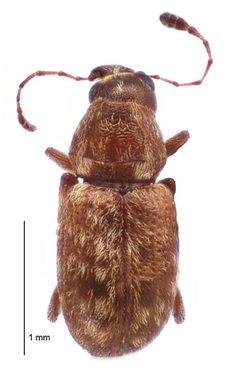
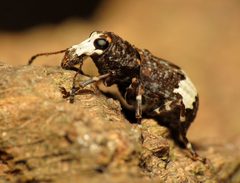
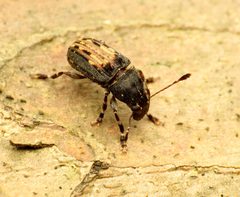
Pronunciation
How to pronounce Anthribinae: //ˌænˈθɹɪbɪniː//
These audio files are automatically generated. While they are not always 100% accurate, they are a good starting point.
Images
Habitat
Gymnognathus , a within Anthribinae, have been observed almost exclusively in tropical moist forests. The presence of G. barclayi in the subtropical Tucuman-Bolivian forest of the southern Bolivian Andes appears facilitated by increased humidity at orographic rain barriers.
Distribution
Neotropical region for Ptychoderini and related . New Caledonia and Vanuatu, with 56 and 9 respectively. Southern Bolivian Andes (Tucuman-Bolivian forest). North America with 12 recognized tribes: Anthribini, Basitropidini, Cratoparini, Discotenini, Gymnognathini, Ischnocerini, Piesocorynini, Platyrhinini, Platystomini, Stenocerini, Trigonorhinini, Tropiderini, and Zygaenodini.
Behavior
Gymnognathus barclayi exhibits calyptrate fly mimicry, with longitudinal pronotal stripe arrangement suggesting mimicry of tachinid or muscid flies. Oviposition has been documented for at least one , Ptychoderes rugicollis.
Sources and further reading
- BugGuide
- Wikipedia
- iNaturalist taxon
- NCBI Taxonomy
- The subfamily Anthribinae in New Caledonia and Vanuatu (Coleoptera: Anthribidae)
- Sexual Dimorphism and Agonistic Behavior of Exechesops Leucopis (Jordan) (Coleoptera: Anthribidae: Anthribinae)
- Revision and cladistic analysis of the genus Ptychoderes Schoenherr, 1823 (Coleoptera, Anthribidae, Anthribinae, Ptychoderini)
- The description of a new calyptrate fly mimicking species of the fungus weevil genus Gymnognathus Schönherr 1826 from the southern Bolivian Andes (Coleoptera: Anthribidae: Anthribinae)