
Brassicogethes aeneus
(Fabricius, 1775)
common pollen beetle, rape pollen beetle, rape blossom beetle
Species Guides
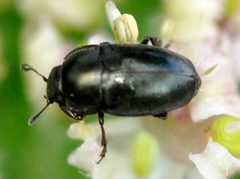
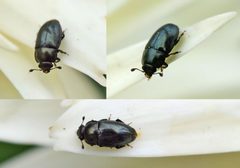
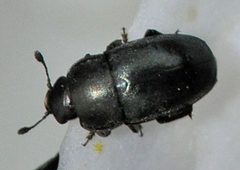
1Brassicogethes aeneus is a small pollen beetle in the Nitidulidae and a major pest of oilseed rape (canola) and other Brassica crops across Europe, Northern Asia, and North America. are 2–3 mm long, metallic black with greenish reflections, while larvae reach 3 mm and are white with brown sclerotized plates. The causes significant economic damage through adult feeding and oviposition in flower buds, which can lead to bud abortion and yield losses up to 80% in spring oilseed rape. It was previously classified under the Meligethes. show low genetic structure across Europe, indicating substantial , and are subject to by hymenopteran .
Pronunciation
How to pronounce Brassicogethes aeneus: /ˌbrasɪkoʊˈɡiːθiːz ˈiːniəs/
These audio files are automatically generated. While they are not always 100% accurate, they are a good starting point.
Identification
Distinguished from similar pollen beetles by its small size (2–3 mm), compact oval shape, and metallic black-green coloration. The combination of feeding damage to oilseed rape buds and larval presence in flowers provides a strong field indicator. Molecular identification via CO1 barcode (797 fragment) is used for definitive identification. Differs from Brassicogethes viridescens and other congenerics in associations and subtle morphological features; precise separation may require microscopic examination or genetic analysis.
Images
Habitat
Primary is agricultural fields of oilseed rape (Brassica napus) and related Brassica crops. Overwinters in woody and sheltered habitats including field margins, hedgerows, and semi-natural areas. In spring, migrate to oilseed rape fields, with abundance typically higher near field edges (within 2 m) and declining with distance into the crop. Adults have been observed in alternative habitats including meadows, land, and field margins where yellow flowers are present in spring; in summer, they occur wherever flowers are available, particularly on crop weeds.
Distribution
Native to and widespread across Europe and Northern Asia (excluding China). Introduced to North America. Documented from the Azores (Faial, Flores, Pico, São Jorge, São Miguel). Genetic studies show weak structure across Europe, with UK populations showing northern affiliations to Scandinavia and the Baltic, and southern affiliations to western continental Europe. Populations in Estonia show some differentiation from the rest of Europe.
Seasonality
with single per year. emerge from sites in spring and migrate to oilseed rape fields. Oviposition occurs during the bud stage of plants. Larval development proceeds through two instars: first instar inside buds, second instar on open flowers. emerge from pupal cocoons in soil the following spring. Adult activity on crops peaks during flowering period; overwintering occurs in protected sites from late summer through winter.
Diet
feed on pollen and nectar in flowers, with feeding on oilseed rape buds causing the primary economic damage. Larvae feed exclusively on pollen: first instar larvae develop inside flower buds, second instar larvae feed on pollen from open flowers. Plant associations of adults are taxonomically broader than those of larvae, which are more restricted to Brassica plants.
Host Associations
- Brassica napus - primary plantoilseed rape/canola, main crop
- Brassica spp. - plantother Brassica crops including vegetable brassicas
- Tersilochus heterocerus - primary larval , ichneumonid
- Phradis interstitialis - larval
- Phradis morionellus - larval
- various yellow-flowered plants - alternative food sourcemeadows, field margins, land in spring
Life Cycle
. overwinter in woody and sheltered , emerging in spring to migrate to oilseed rape fields. Females lay in flower buds of plants. Larvae pass through two instars: first instar develops inside buds, second instar feeds on pollen in open flowers. Larvae drop to the ground to pupate in soil. Adult emerge from pupal cocoons in soil the following spring. The shows evidence of recent demographic expansion across Europe, possibly linked to increased oilseed rape .
Behavior
exhibit spring from sites to oilseed rape fields, with mean distance estimated at 1.2 km based on genetic and statistical models. Within fields, adults aggregate near field edges, with abundance declining with distance from crop margins. Adults feed on buds, causing bud abortion through feeding damage and oviposition; this represents the primary damage mechanism rather than larval feeding. Adults and larvae both feed on pollen and nectar. Adults are active during flowering period, with peak activity in morning and evening. The shows substantial across Europe, indicating effective long-distance dispersal.
Ecological Role
Major agricultural pest of oilseed rape, capable of causing yield losses up to 80% in spring-sown crops through bud damage. Serves as for at least nine hymenopteran , with Tersilochus heterocerus as the primary agent. Larval rates commonly reach 66–72% and can exceed 90% in some fields, contributing to natural pest suppression. High parasitism rates are associated with landscape complexity, particularly when semi-natural exceed 18% within 1 km of fields. The species may contribute to pollination of oilseed rape, though this has not been confirmed. applications can disrupt biological control by reducing parasitoid or, paradoxically, may increase crop attractiveness to pollen beetles in subsequent years.
Human Relevance
Significant economic pest of oilseed rape (canola) production across Europe and expanding regions. Damage occurs through bud abortion and reduced seed set, with used to guide application decisions. Subject to intensive insecticide use, which has selected for resistance in many European ; resistance ratios up to 500-fold for deltamethrin have been documented. Resistance management strategies including pyrethroid reduction have shown effectiveness in reducing resistance levels. agriculture approaches using computer vision (YOLOv4) have been developed for real-time detection and site-specific application to reduce chemical use. Target of research focusing on conservation of natural populations through landscape management.
Similar Taxa
- Brassicogethes viridescensSimilar size, coloration, and ; may require microscopic or genetic examination for separation
- Meligethes spp.Formerly classified in same ; morphologically similar pollen beetles with overlapping ranges
- Xenostrongylus variegatusCo-occurring rapeseed pest in China; distinguished by leaf-feeding habit versus flower-feeding in B. aeneus, and mouthpart differences
More Details
Genetic structure
show limited genetic differentiation across Europe, with isolation by distance significant only at continental . Estonian populations show some differentiation from the rest of Europe. Demographic modeling indicates recent population expansion, likely associated with increased oilseed rape area.
Insecticide resistance
Widespread resistance documented across Europe, with varying resistance ratios to different compounds. No kdr mutation detected; resistance mechanisms appear metabolic. Resistance levels decreased following implementation of insect resistance management with pyrethroid reduction.
Landscape effects
Abundance and are influenced by landscape context. High parasitism rates (>66%) maintained when semi-natural comprise >35% of landscape within 1 km; decision tree analysis suggests >18% semi-natural habitat needed for effective . Specific adjacent habitat types show less consistent effects than overall landscape complexity.
Nomenclatural history
Transferred from Meligethes to Brassicogethes based on phylogenetic revision; B. aeneus dauricus recognized in some treatments.
Sources and further reading
- BugGuide
- Wikipedia
- GBIF taxonomy match
- iNaturalist taxon
- NCBI Taxonomy
- Encyrtid Holdings | Entomology Research Museum
- Managing Insect Pests of Texas Sunflowers - AgriLife Extension Entomology
- Learning the Insect Lingo While Working Abroad
- Nomenclatural changes in Phymatodes | Beetles In The Bush
- Bug Eric: More Insects From Sunflowers
- The Drugs (Neonicotinoids) Don’t Work 2 - Buglife Blog - Buglife
- Landscape complexity effects on Brassicogethes aeneus abundance and larval parasitism rate: a two-year field study
- Deep Learning for Real-Time Detection of Brassicogethes aeneus in Oilseed Rape Using the YOLOv4 Architecture
- Effects of insecticide application on parasitism rates of pollen beetle larvae (Brassicogethes aeneus (Fabricius)) by tersilochine parasitoids
- Dynamique des populations de méligèthes, Brassicogethes aeneus Fabr. (Coleoptera, Nitidulidae) et de son principal parasitoïde, Tersilochus heterocerus Thomson (Hymenoptera, Ichneumonidae) en fonction de l’hétérogénéité des paysages agricoles
- Impact of oilseed rape crop management systems on the spatial distribution of Brassicogethes aeneus (Fabricius 1775): Implications for integrated pest management
- Seven‐year monitoring of pyrethroid resistance in the pollen beetle (Brassicogethes aeneus F.) during implementation of insect resistance management
- Spatio-temporal Distributions and Associations of Cabbage Stem Weevil (Ceutorhynchus Pallidactylus Marsham, 1802) and Pollen Beetle (Brassicogethes Aeneus Fabricius, 1775) in winter oilseed rape
- Molecular taxonomic analysis of the plant associations of adult pollen beetles (Nitidulidae: Meligethinae), and the population structure of Brassicogethes aeneus
- Comparison of Mouthpart Sensilla of Two Rapeseed Pests ( Xenostrongylus variegatus and Brassicogethes aeneus ) Using Scanning Electron Microscopy (Coleoptera: Nitidulidae)
- Limited genetic structure and demographic expansion of the Brassicogethes aeneus populations in France and in Europe
- Coumarin-1,2,4-Triazole hybrids as potential agents against Brassicogethes aeneus (Fabricius 1775).