
Carpophilus corticinus
Erichson, 1843
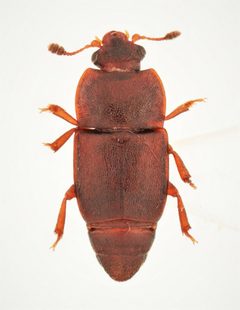
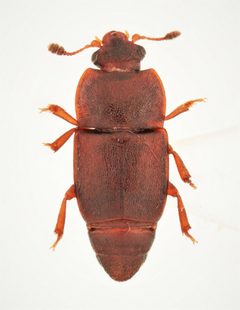
Carpophilus corticinus is a of sap-feeding beetle in the Nitidulidae. It has been recorded in North America. The species belongs to a containing several economically significant pests, though specific information about C. corticinus itself is limited. It has been observed to be cross-attracted to the of Carpophilus sayi.
Pronunciation
How to pronounce Carpophilus corticinus: //kɑrˈpoʊfɪləs kɔrˈtɪsɪnəs//
These audio files are automatically generated. While they are not always 100% accurate, they are a good starting point.
Identification
The can be distinguished from Carpophilus sayi and Carpophilus lugubris by its lack of species-specific production; C. sayi and C. lugubris produce male-specific pheromones that are not produced by C. corticinus. Specific morphological distinguishing features from are not documented in available sources.
Images
Distribution
North America. Distribution records are sparse, with only 8 observations documented on iNaturalist.
Behavior
Has been observed to be cross-attracted to the synergized of Carpophilus sayi when combined with fermenting whole wheat bread dough. This cross-attraction was documented in Minnesota oak woodlands during field trials.
Similar Taxa
- Carpophilus sayiC. sayi produces a male-specific that cross-attracts C. corticinus; C. sayi is a documented of (Ceratocystis fagacearum), a role not established for C. corticinus
- Carpophilus lugubrisClosely related with similar chemistry; C. lugubris produces male-specific pheromone compounds that are not produced by C. corticinus
- Carpophilus truncatusCongeneric pest of almonds and pistachios; distinguished by its documented economic impact and specific associations with tree nuts, which are not established for C. corticinus
- Carpophilus hemipterusCongeneric with established laboratory rearing methods on bananas and sand; no such rearing protocols have been documented for C. corticinus
More Details
Pheromone cross-attraction
In field trials in Minnesota oak woodlands, C. corticinus was clearly cross-attracted to a synthetic mixture of the two major compounds of C. sayi combined with fermenting whole wheat bread dough. This indicates potential for pheromone-based monitoring to incidentally capture C. corticinus, which may complicate surveillance efforts targeting C. sayi as an .