
Languria mozardi
Latreille, 1807
clover stem borer
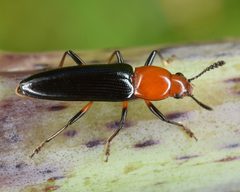
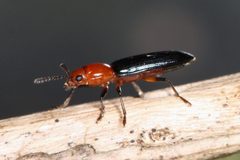
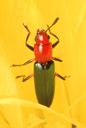
Languria mozardi is a small lizard beetle (Coleoptera: Erotylidae) commonly known as the clover stem borer. are red and black, measuring 4–9 mm in length. The is native to North and Central America, with larvae developing inside the stems of plants. Multiple host records document its presence on agricultural crops, including clover, canola, and soybeans.
Pronunciation
How to pronounce Languria mozardi: //læŋˈɡjʊəriə moʊˈzɑːrdi//
These audio files are automatically generated. While they are not always 100% accurate, they are a good starting point.
Identification
distinguished by red and black coloration and small size (4–9 mm). The combination of bright red with black markings and the compact, somewhat flattened body shape is characteristic of the Languria. Larval presence is indicated by stem boring damage in plants.
Images
Habitat
Agricultural fields and areas where plants occur. have been observed on a variety of plants, while larvae develop within stems.
Distribution
Central America and North America. Specific regional records include Manitoba, Canada.
Diet
Larvae feed internally within stems of plants. Documented hosts include red clover (Trifolium pratense), canola, and soybeans (Glycine max).
Host Associations
- Trifolium pratense - larval development in stemsprimary implied by
- canola - new record; larval stem boringdocumented in Florida Entomologist 2007
- Glycine max (soybeans) - new recorddocumented in Florida Entomologist 2010
Life Cycle
Larval development occurs within plant stems. Specific details of , pupal, and timing are not documented in available sources.
Behavior
Stem boring : larvae tunnel inside plant stems, potentially weakening plants. are found on vegetation but specific adult behaviors are not well documented.
Human Relevance
Documented as a pest of agricultural crops including canola and soybeans. The ' expansion to multiple crop suggests potential economic significance in agricultural systems, though specific damage assessments are not detailed in available sources.
Similar Taxa
- other Languria speciesSimilar red and black coloration and body form; identification requires examination of subtle morphological characters not detailed in available sources
- other Erotylidae (lizard beetles)Shared characteristics including compact body and often bright coloration; Languria specifically associated with stem boring in herbaceous plants
Sources and further reading
- BugGuide
- Wikipedia
- GBIF taxonomy match
- iNaturalist taxon
- NCBI Taxonomy
- Occurrence of Clover Stem Borer, Languria mozardi (Coleoptera: Languriidae), on Canola: A New Host Record
- What is a host plant? Plants used by Languria mozardi Latreille 1807 (Coleoptera: Erotylidae: Languriinae): a review
- Clover Stem Borer,Languria mozardi(Coleoptera: Languriidae), on Soybeans,Glycine max: A New Host Record