
Languria
Latreille, 1802
lizard beetles
Species Guides
9- Languria angustata(lizard beetle)
- Languria bicolor
- Languria convexicollis(lizard beetle)
- Languria denticulata
- Languria discoidea(lizard beetle)
- Languria laeta(Plains Poppy Lizard Beetle)
- Languria mozardi(clover stem borer)
- Languria taedata(lizard beetle)
- Languria trifasciata(Three-banded lizard beetle)
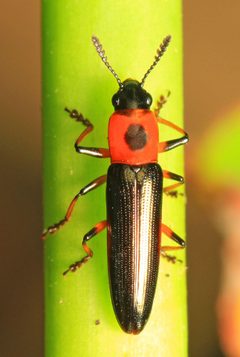
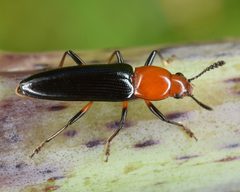
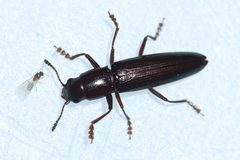
Languria is a of lizard beetles (Coleoptera: Erotylidae: Languriinae) established by Latreille in 1802. The genus contains approximately 15-18 described distributed primarily in North America and the Oriental Region. Members are characterized by their association with plant stems, where larvae develop as internal borers. Several species have been documented as agricultural pests when they colonize cultivated crops outside their native range.
Pronunciation
How to pronounce Languria: /læŋˈɡʊriə/
These audio files are automatically generated. While they are not always 100% accurate, they are a good starting point.
Images
Habitat
Coastal marshes and grassland ; specifically documented in Spartina alterniflora marshes along the Gulf Coast of the United States. Larvae inhabit internal stem tissues of plants.
Distribution
North America (eastern coastal regions, western Gulf Coast); Oriental Region. Specific distribution varies by : L. taedata occurs along eastern coastal North America with polymorphic in Louisiana coastal marshes; L. mozardi has expanded range into agricultural systems.
Diet
Phytophagous; larvae feed internally within plant stems. Documented plants include Spartina alterniflora (smooth cordgrass), clover (Trifolium), canola, and soybean (Glycine max).
Host Associations
- Spartina alterniflora - larval Primary in coastal marsh ; larvae feed within stems
- Trifolium - larval Implied by 'clover stem borer' for L. mozardi
- Brassica napus - larval Canola documented as new record for L. mozardi
- Glycine max - larval Soybean documented as new record for L. mozardi
Life Cycle
Complete with documented stages including larvae and pupae. Larvae are internal stem borers. have been documented attacking immature stages.
Behavior
Larvae bore into plant stems and develop internally. are associated with plants where oviposition occurs.
Ecological Role
Herbivore; stem-boring larvae impact plant . Documented relationships suggest role in as host for natural enemies. Some function as occasional agricultural pests when host range expands to cultivated crops.
Human Relevance
Minor agricultural pest status: L. mozardi (clover stem borer) has been documented on canola and soybean as new records, indicating potential for economic impact when expand from native clover hosts into crop systems.
Similar Taxa
- SerralanguriaNewly described Oriental established by transferring one from Languria; distinguished by morphological characters requiring examination of
More Details
Taxonomic History
Languria erythrocephalus Blatchley, 1924 has been synonymized with L. taedata LeConte, 1854 based on examination of and geographic variation. An all- 'Form C' of L. taedata was discovered along the western Gulf Coast, representing the first such color morph in the .
Polymorphism
L. taedata exhibits significant in North American , with color variation previously leading to description of distinct now recognized as synonyms.
Sources and further reading
- BugGuide
- Wikipedia
- GBIF taxonomy match
- iNaturalist taxon
- NCBI Taxonomy
- Catalogue of Life
- Languria erythrocephalus: Host Plants, Immature Stages, Parasites, and Habits (Coleoptera: Languriidae)
- Occurrence of Clover Stem Borer, Languria mozardi (Coleoptera: Languriidae), on Canola: A New Host Record
- What is a host plant? Plants used by Languria mozardi Latreille 1807 (Coleoptera: Erotylidae: Languriinae): a review
- Clover Stem Borer,Languria mozardi(Coleoptera: Languriidae), on Soybeans,Glycine max: A New Host Record
- Polymorphism in Languria taedata LeConte, its occurrence in coastal Louisiana Spartina marshes, and clarification of some Motschulsky languriine types (Coleoptera: Erotylidae: Languriinae)
- Serralanguria, a new genus of Languriini (Coleoptera, Erotylidae) from the Oriental Region, including one new species and one species transferred from the genus Languria.