
Latridius
Herbst, 1793
Species Guides
4- Latridius consimilis
- Latridius hirtus
- Latridius minutus(squarenosed fungus beetle)
- Latridius protensicollis
Latridius is a of minute brown scavenger beetles in the Latridiidae, established by Herbst in 1793. The genus contains at least 16 described distributed across the Holarctic region, with records from Europe, North America, and Asia. Species within this genus are small, cryptic beetles associated with decaying plant matter and fungal growth. The genus is part of the superfamily Coccinelloidea, though its members bear little resemblance to the more familiar lady beetles.
Pronunciation
How to pronounce Latridius: //læˈtrɪdiːəs//
These audio files are automatically generated. While they are not always 100% accurate, they are a good starting point.
Identification
Distinguished from other Latridiidae by the combination of: with 3-segmented club; pronotum with distinct lateral margins that are often reflexed or explanate; and with punctate or rather than smooth or reticulate surface. Differs from Cartodere by the more elongate body form and less rounded pronotum. Separation from Dienerella requires examination of antennal club structure and male genitalia. -level identification relies on subtle differences in elytral punctation, pronotal shape, and body proportions, often requiring microscopic examination.
Images
Appearance
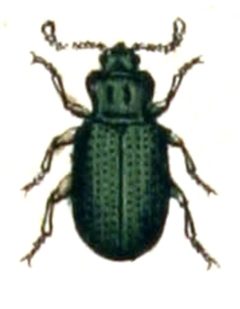
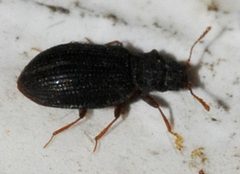
Small, elongate-oval beetles, typically 1.5–3 mm in length. Body somewhat flattened dorsoventrally, with a dull, often pubescent surface. 11-segmented, with a loose, 3-segmented club. with distinct punctation or ; some with crenulate (scalloped) elytral margins. Coloration generally brown to dark brown, occasionally blackish. Pronotum narrower than elytra at base, with lateral margins often explanate.
Habitat
Found in moist, decaying organic matter, particularly where fungal growth is present. include leaf litter, compost, decaying wood, stored organic products, and bird or mammal nests. Many show affinity for environments with active mold growth. Some species occur in drier situations such as deserts (e.g., L. desertus).
Distribution
Holarctic distribution with records from Europe (including Scandinavia), North America, and Asia (Mongolia, Canary Islands). European records include Denmark, Norway, and Sweden. North American documented across temperate regions. Individual species show varying ranges: L. minutus is widespread in the Palearctic; L. desertus and L. nigritus occur in western North America; L. mongolicus is known from Central Asia.
Diet
Feeds on fungal and spores, particularly molds (Deuteromycetes and related groups). Has been observed grazing on surface growth of fungi in decaying plant substrates.
Life Cycle
Complete with , larval, pupal, and stages. Larvae are small, active, and inhabit the same substrates as adults. Developmental timing varies with and environmental conditions; multiple per year likely in favorable conditions.
Behavior
Slow-moving, cryptic beetles that remain concealed within substrate. and larvae are negatively phototactic, remaining in dark, humid microhabitats. Capable of surviving in low-moisture environments through physiological adaptations to .
Ecological Role
Decomposer and fungivore, contributing to nutrient cycling in decaying organic matter. Part of the of microarthropods that regulate fungal in soil and litter systems.
Human Relevance
Occasional pest of stored products, particularly dried goods, spices, and materials with mold . Some reported from households where damp conditions promote fungal growth. Generally of minor economic importance; presence often indicates moisture or mold problems rather than primary .
Similar Taxa
- DienerellaAlso in Latridiidae with similar size and ; differs in antennal club structure and more rounded body form
- CartodereOverlaps in distribution and ; distinguished by more rounded, compact body and smoother
- ThesSimilar minute brown scavenger beetles; requires examination of pronotal and antennal characters for separation
More Details
Taxonomic stability
The has remained taxonomically stable since its establishment, though -level revisions have occurred, particularly for North American in the 1970s (Johnson, 1977; Sen Gupta, 1976).
Phylogenetic position
Molecular and morphological evidence places Latridius within the Latridiinae, a group historically allied with both Cerylonidae (now Coccinelloidea) and Corylophidae. Current classification in Coccinelloidea reflects revised understanding of Cucujiformia relationships.