
Cartodere
C.G. Thomson, 1859
Species Guides
4- Cartodere australica
- Cartodere bifasciata(minute brown scavenger beetle)
- Cartodere constricta(Plaster Beetle)
- Cartodere nodifer(Swollen Fungus Beetle)
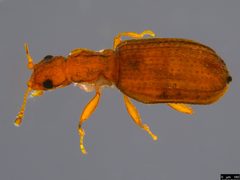
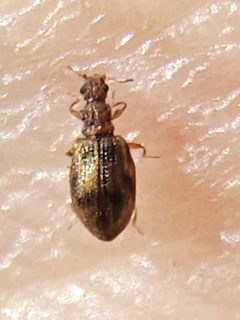
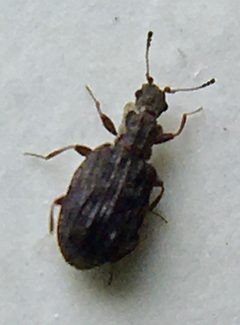
Cartodere is a of minute brown scavenger beetles in the Latridiidae. in this genus are characterized by distinctive morphological features including deeply incised pronotum margins and large with over 70 . The genus has a distribution and occurs in both natural and human-associated environments such as stored grain products.
Pronunciation
How to pronounce Cartodere: //kɑr.toʊˈdɛr.i//
These audio files are automatically generated. While they are not always 100% accurate, they are a good starting point.
Identification
Distinguished from other Latridiidae by the combination of deeply incised pronotum margins, large with over 70 , and with eight or fewer rows of punctate . The separated procoxae via a prosternal process provides additional diagnostic value.
Images
Appearance
Small beetles with deeply incised margins on the pronotum. are large, each containing more than 70 . bear eight or fewer rows of punctate . Procoxae are separated by a distinct prosternal process.
Habitat
In natural environments, found in herbaceous vegetation, straw, grass, mouldy bark, hay, wood, moss, compost, and animal nests. occur in stored food products in houses, grain elevators, and feed mills.
Distribution
; recorded from Denmark, Norway, Sweden, and worldwide.
Diet
Larvae and feed on mould growing on dead organic material.
Host Associations
- Tarsonemus ascitus - phoretic female mites attach primarily to lateral and undersides of the prothorax
Behavior
Serves as a phoretic for mites; specifically documented as a carrier for Tarsonemus ascitus with mites showing preference for attachment sites on the prothorax.
Ecological Role
Decomposer; feeds on mould in decaying organic matter, contributing to nutrient cycling in both natural and stored product environments.
Human Relevance
Occasional pest of stored grain products; presence in grain elevators and feed mills may indicate mould . Documented as a for phoretic mites that may have implications for grain storage .
More Details
Phoretic mite spatial distribution
On Cartodere constricta, phoretic Tarsonemus ascitus mites exhibit a negative binomial spatial distribution, with mean mite counts consistently lower than variance. This pattern has been used to calculate needed for reliable mite estimates.