
Cartodere constricta
(Gyllenhal, 1827)
Plaster Beetle
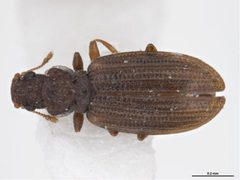
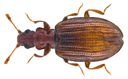
Cartodere constricta, commonly known as the plaster beetle, is a minute lathridiid measuring 1.3–2.0 mm in length. Native to the Palearctic region, it has become established in the Nearctic through human-mediated . The is a mold feeder associated with stored products, buildings, and organic debris in dry environments. It serves as a documented phoretic for the mite Tarsonemus ascitus, which attaches specifically to the lateral and underside surfaces of the beetle's prothorax.
Pronunciation
How to pronounce Cartodere constricta: /kɑːrtoʊˈdɪəri kənˈstrɪktə/
These audio files are automatically generated. While they are not always 100% accurate, they are a good starting point.
Identification
Distinguished from other small beetles in stored product environments by its extremely small size (1.3–2.0 mm), brown coloration, and compact latridiid body form. Separation from congeneric and other Latridiidae requires microscopic examination; specific diagnostic characters for field identification are not documented in available sources. The 'plaster beetle' derives from its association with mold growth on damp plaster in buildings.
Images
Appearance
Extremely small , 1.3–2.0 mm in length. Body form typical of minute brown scavenger beetles ( Latridiidae): compact, somewhat flattened, with short and legs. Coloration generally brown. Specific morphological details beyond size and family-level characteristics are not well documented in available sources.
Habitat
Stored products such as grains and dried fruit; buildings including houses, feed mills, and grain elevators; organic substrates including manure heaps and plant detritus. Consistently associated with mold growth in dry to moderately moist environments. Control requires reducing relative humidity below 20% to eliminate mold food source.
Distribution
Native to the Palearctic: throughout Europe and North Africa, east across Siberia to the Russian Far East, south to Pakistan, India, China, and Japan. Introduced and established in the Nearctic: southern Canada and throughout the United States. Also recorded from the Galápagos Islands.
Diet
Mold feeder; consumes fungal growth on organic substrates.
Host Associations
- Tarsonemus ascitus - phoretic mite female mites attach preferentially to lateral and undersides of prothorax; first recorded phoretic association for this mite
Behavior
Human Relevance
Pest of stored products and buildings; presence indicates excessive moisture and mold growth. Management requires drying affected areas to reduce relative humidity below 20%, thereby eliminating mold food source. Used as model organism in studies of phoretic mite spatial distribution and sampling methodology.
Similar Taxa
- Other LatridiidaeSimilar minute size and brown coloration; microscopic examination required for definitive identification to
- Other stored product beetles (e.g., some Cryptophagidae, Mycetophagidae)Overlap in and size range; -level characters distinguish Latridiidae
More Details
Phoretic Mite Association
The spatial distribution of Tarsonemus ascitus on C. constricta has been mathematically characterized, enabling calculation of needed to estimate mite with predetermined . This represents a rare quantitative treatment of phoretic mite- relationships.
Sources and further reading
- BugGuide
- Wikipedia
- GBIF taxonomy match
- iNaturalist taxon
- NCBI Taxonomy
- Bug Eric: Moth Monday: Palo Verde Webworm
- A new species of Xenorhipus from Baja California | Beetles In The Bush
- Belostomatidae | Beetles In The Bush
- FIRST RECORDS OF PHORETIC BEHAVIOUR OF TARSONEMUS ASCITUS DELFINADO (ACARINA: TARSONEMIDAE) ON GRAIN-INHABITING BEETLES AND ITS SPATIAL DISTRIBUTION ON CARTODERE CONSTRICTA (GYLLENHAL) (COLEOPTERA: LATHRIDIIDAE)