
Scymnus marginicollis
Mannerheim, 1843
dusky lady beetle
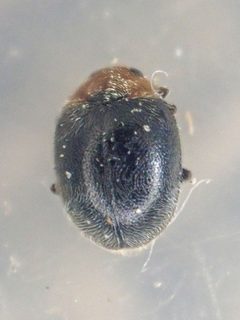
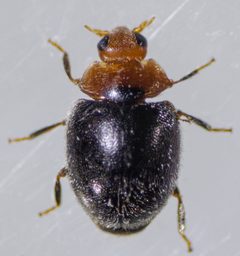
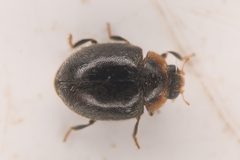
Scymnus marginicollis is a of dusky lady beetle in the Coccinellidae, first described by Mannerheim in 1843. It is recognized as a member of the Scymninae, a group of small lady beetles often referred to as 'dusky' or 'scymnine' lady beetles due to their typically dull coloration compared to the brightly colored Coccinellinae. The species is known to occur across North America with two recognized : S. marginicollis marginicollis and S. marginicollis borealis.
Pronunciation
How to pronounce Scymnus marginicollis: /ˈsɪmnəs ˌmɑrdʒɪˈnɪkɔlɪs/
These audio files are automatically generated. While they are not always 100% accurate, they are a good starting point.
Identification
Members of the Scymnus are small lady beetles, typically 1.5–3 mm in length, with oval to elongated bodies. Scymnus marginicollis can be distinguished from other Scymnus and from the more commonly encountered Coccinellinae (such as Coccinella septempunctata or Harmonia axyridis) by its smaller size, more subdued coloration (typically brown to blackish), and the structure of the pronotal margin. The specific epithet 'marginicollis' refers to characteristics of the pronotal margin. Identification to species level requires examination of genitalic structures and other microscopic features.
Images
Distribution
North America, with records from Canada (Alberta, British Columbia, Ontario) and the United States. The S. marginicollis borealis occurs in northern regions, while the nominate subspecies S. marginicollis marginicollis has a broader distribution.
Ecological Role
Human Relevance
Scymnus , including S. marginicollis, contribute to of pest aphids and are considered beneficial in managed landscapes and agricultural settings. However, their small size and cryptic coloration make them less conspicuous than larger lady beetles, so they are often overlooked in general observations.
Similar Taxa
- Scymnus other speciesOther Scymnus share the small size, dull coloration, and general body form. Differentiation requires examination of specific morphological characters including pronotal shape, elytral punctation, and male genitalia.
- Coccinellinae (e.g., Coccinella, Harmonia)Larger, more brightly colored lady beetles with contrasting spot patterns. Scymnus marginicollis is smaller (typically under 3 mm), more elongate, and lacks the vivid red, orange, or yellow coloration with bold black markings typical of many Coccinellinae.
- Stethorus speciesAnother of small lady beetles in Scymninae, also predatory on small arthropods including spider mites. Stethorus are often similar in size and coloration to Scymnus; separation requires careful examination of tarsal structure and other detailed morphological features.