
Hyperaspis proba
(Say, 1826)
esteemed lady beetle, esteemed sigil lady beetle
Hyperaspis proba, commonly known as the esteemed lady beetle, is a small of lady beetle in the Coccinellidae. It is native to North America with a recorded range extending from Maine to South Carolina and westward to South Dakota and western Texas. measure approximately 2–3 mm in length and exhibit in pronotal coloration.
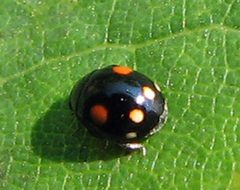
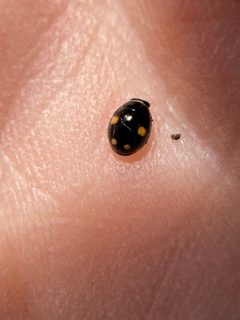
Pronunciation
How to pronounce Hyperaspis proba: //haɪˈpɛrəs.pɪs ˈproʊ.bə//
These audio files are automatically generated. While they are not always 100% accurate, they are a good starting point.
Identification
Distinguished from other Hyperaspis and small lady beetles by the specific pattern of three spots on the combined with the sexually dimorphic pronotal coloration. The small size (2–3 mm) and the particular arrangement of yellow or red elytral spots help separate it from similar species such as other Hyperaspis with different spot patterns or slightly larger Coccinellidae.
Images
Appearance
are small, measuring 2–3 mm in length. The pronotum shows distinct : males have a yellow margin and lateral area, while females have a black anterior margin with yellow lateral areas. The bear three yellow or red spots. The overall body form is compact and typical of small coccinellid beetles.
Distribution
Recorded from North America, specifically from Maine south to South Carolina, and west to South Dakota and western Texas. Additional records include the Canadian provinces of Manitoba, Ontario, and Québec.
Similar Taxa
- Other Hyperaspis speciesShare similar small size and general body plan, but differ in spot number, arrangement, and pronotal coloration patterns
- Small Coccinellidae (e.g., some Scymnus or Stethorus)Overlap in size range but differ in elytral spot patterns and pronotal
More Details
Sexual dimorphism
The distinct difference in pronotal coloration between males and females is a notable feature of this , with males showing more extensive yellow markings on the pronotum.
Sources and further reading
- BugGuide
- Wikipedia
- GBIF taxonomy match
- iNaturalist taxon
- NCBI Taxonomy
- Why Rodney Dangerfield Would Have Liked Male Ants--and Probably What Brendon Boudinot Is Doing | Bug Squad
- About That Cherry Tree... | Bug Squad
- Waxy lady beetles come to the rescue of pest-plagued crapemyrtles, Hyperaspis spp. — Bug of the Week
- How One Entomologist Made His Way From Academic Probation to the Smithsonian
- What's Eating Your Pine Needles? Sawflies, Probably
- Archive — Bug of the Week