
Diomus terminatus
(Say, 1835)
Firefly Duskyling
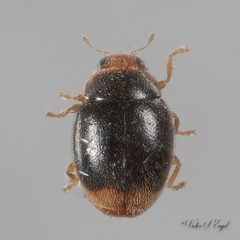
Diomus terminatus is a minute lady beetle native to eastern North America, measuring 1.5–2 mm. It has been evaluated for of sugarcane aphids, particularly Melanaphis sacchari and Sipha flava. Laboratory studies confirm its complete development on prey, with a time of approximately 12 days from to at 26°C.


Pronunciation
How to pronounce Diomus terminatus: /ˈdiː.oʊ.məs tɛr.mɪˈneɪ.təs/
These audio files are automatically generated. While they are not always 100% accurate, they are a good starting point.
Identification
Distinguished from other small Coccinellidae by the combination of minute size (1.5–2 mm), brown coloration with reddish elytral apex, and dense gold setae giving a hairy appearance. First instar larvae differ from later instars in relative size and abundance of specialized setae.
Images
Appearance
Brown, oval-shaped body with a reddish tinge at the portion of the . Covered in gold-colored setae, giving a slightly hairy appearance. Length 1.5–2 mm.
Habitat
Associated with sugarcane agroecosystems and supporting . Field-collected specimens have been reared on sugarcane leaves infested with aphids.
Distribution
Eastern North America; recorded from Ontario, Québec, Vermont, and Bermuda.
Diet
of aphids. Laboratory studies confirm consumption of Melanaphis sacchari (sugarcane aphid) and Sipha flava (yellow sugarcane aphid). Prey likely includes additional aphids, scale insects, and .
Host Associations
- Melanaphis sacchari - preysugarcane aphid; laboratory rearing confirmed
- Sipha flava - preyyellow sugarcane aphid
Life Cycle
stage lasts 4.5 days. Larval stage averages 6.8 days; pupal stage 4.9 days. Total development from egg hatch to averages 12.1 days at 26°C. First and fourth instars show dramatic differences in size and abundance of specialized setae.
Ecological Role
of pests; evaluated as agent in Louisiana sugarcane systems. Larvae consume approximately 30 aphid nymphs total (4.7 per day); consume up to 19 aphids per day.
Human Relevance
Investigated for of sugarcane aphids in agricultural settings. Not known to be a household or garden pest.
Similar Taxa
- Other Diomus speciesSimilar minute size and general body form; requires examination of setal patterns and coloration details for separation
- Other small CoccinellidaeSize overlap with several ; D. terminatus distinguished by reddish elytral apex and dense gold setae
More Details
Laboratory biology
longevity averages 26 days when feeding on mixed-age aphids in petri dish conditions.
Taxonomic note
Described by Thomas Say in 1835.
Sources and further reading
- BugGuide
- Wikipedia
- GBIF taxonomy match
- iNaturalist taxon
- NCBI Taxonomy
- MORPHOLOGY AND BIOLOGY OF DIOMUS TERMINATUS (COLEOPTERA: COCCINELLIDAE), A PREDATOR OF SIPHA FLAVA (HOMOPTERA: APHIDAE)
- Life Cycle and Larval Morphology of Diomus Terminatus (Coleoptera: Coccinellidae) and its Potential as a Biological Control Agent of Melanaphis Sacchari (Hemiptera: Aphididae)