
Psyllobora renifer
Casey, 1899
Kidney-spotted Fairy Lady Beetle, Kidney-spotted Psyllobora, Kidney-spotted Lady Beetle
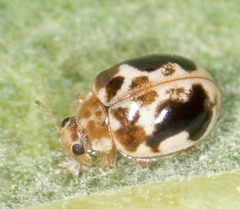
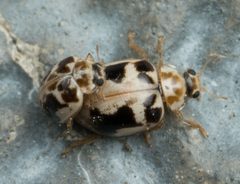
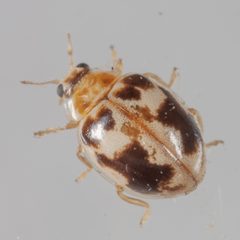
Psyllobora renifer is a minute lady beetle distinguished by its unique kidney-shaped markings and specialized diet of powdery mildew fungi. At 1.75–2.4 mm, it is among the smallest lady beetles in North America. Unlike most lady beetles that prey on aphids and soft-bodied insects, this has evolved to exploit fungal of plants as its primary food source. It occurs across North and Central America and is most reliably identified by the confluent, connected dark patches on its that merge into larger irregular shapes rather than remaining as discrete spots.
Pronunciation
How to pronounce Psyllobora renifer: /ˌsɪləˈbɔːrɑ ˈrɛnɪfər/
These audio files are automatically generated. While they are not always 100% accurate, they are a good starting point.
Identification
Distinguished from by the confluent, merging nature of the elytral dark patches—other Psyllobora typically show more discrete, separated spots. The kidney shape of the markings and the extremely small size (1.75–2.4 mm) further separate it from larger lady beetles. Within Psyllobora, P. vigintimaculata (20-spotted Lady Beetle) has more numerous, smaller, and distinctly separate spots. The pale pronotal markings and overall delicate build are consistent with the but the connected elytral pattern is diagnostic for this species.
Images
Appearance
are extremely small, measuring 1.75–2.4 mm in length. The bear dark, kidney-shaped splotches that are notably confluent—merging into larger connected patches rather than remaining as separate discrete spots. The pronotum carries lighter splotches. Body form is typical of the Psyllobora: rounded, somewhat flattened, and delicate in appearance compared to larger, more robust lady beetles.
Habitat
Associated with vegetation bearing powdery mildew ; likely occurs in diverse including forests, gardens, and agricultural settings where fungi are present. Specific microhabitat preferences are poorly documented but inferred from food source requirements.
Distribution
Recorded from North America and Central America. GBIF distribution records confirm presence in Middle America and North America. Specific range boundaries within these regions are not well documented.
Diet
Powdery mildew fungi (Erysiphales); one of the few lady beetles with a documented fungal diet rather than predatory or mixed feeding habits.
Host Associations
- Powdery mildew - foodPrimary food source; specific fungal not documented
Behavior
activity has been observed; individuals have been collected at blacklight traps, suggesting they fly at night and are attracted to light sources.
Ecological Role
Mycophagous lady beetle that feeds on powdery mildew fungi, potentially providing incidental of plant . The ecological significance of this feeding habit—whether it substantially reduces fungal pressure on plants—is unknown.
Human Relevance
Potential value as a agent for powdery mildew in gardens and agriculture, though this has not been formally evaluated or commercially developed. The is too small and inconspicuous to attract general public attention.
Similar Taxa
- Psyllobora vigintimaculataAlso small and pale with dark spots, but has approximately 20 discrete, separate spots rather than the confluent kidney-shaped patches of P. renifer; commonly known as 20-spotted Lady Beetle
- Other Psyllobora speciesShare small size and general body plan, but differ in spot pattern—most have more discrete, separated elytral markings rather than the merged, confluent patches characteristic of P. renifer
More Details
Mycophagy in Coccinellidae
Psyllobora renifer belongs to a small group of lady beetles that have evolved to feed on fungi rather than the aphids, scale insects, or mites that constitute the typical diet of most Coccinellidae. This dietary specialization is relatively rare in the and represents a distinct ecological strategy.
Taxonomic history
Described by Thomas L. Casey in 1899, a prolific American entomologist who described thousands of . The species epithet 'renifer' refers to the kidney-shaped () markings.