
Hippodamia arctica
(Schneider, 1792)
Arctic lady beetle
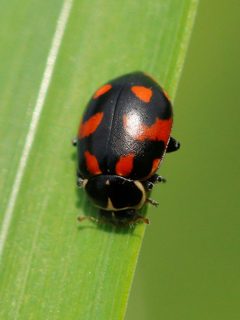
Hippodamia arctica is a small lady beetle in the Coccinellidae with a Holarctic distribution spanning Europe, Northern Asia (excluding China), and North America. measure approximately 4–4.5 mm and display a distinctive black body with yellowish-red markings. The species inhabits northern and arctic-alpine regions, with records from British Columbia, Labrador, Yukon, Alaska, and across northern Eurasia.
Pronunciation
How to pronounce Hippodamia arctica: /hɪpoʊˈdeɪmiə ɑːrkˈtɪkə/
These audio files are automatically generated. While they are not always 100% accurate, they are a good starting point.
Identification
The small size (4–4.5 mm) and black coloration with yellowish-red markings distinguish this from many other Hippodamia. Separation from similar small, dark Hippodamia species requires examination of subtle elytral pattern details and genitalia; specific diagnostic characters are not documented in available sources. The Holarctic northern distribution may aid in narrowing identification possibilities in appropriate geographic contexts.
Images
Habitat
Northern and arctic-alpine environments. Specific microhabitat preferences are not documented.
Distribution
Holarctic: Europe and Northern Asia (excluding China); North America including British Columbia, Labrador, Yukon, and Alaska.
Similar Taxa
- Hippodamia convergensSimilar and general lady beetle , but H. convergens is larger (6–7 mm), has converging pale lines on the pronotum, and is distributed across North America including temperate regions rather than restricted to northern areas.
More Details
Taxonomic authority
The was described by Schneider in 1792, making it one of the earlier described Hippodamia species.
Observation rarity
As of available records, the has relatively few documented observations (23 on iNaturalist), suggesting it may be genuinely uncommon, underreported, or restricted to remote northern with limited survey effort.
Sources and further reading
- BugGuide
- Wikipedia
- GBIF taxonomy match
- iNaturalist taxon
- NCBI Taxonomy
- Birds, Bats or a Bloom? But No Splat! | Bug Squad
- Bug Eric: One of These is Not Like the Others....
- Researchers Share New Method for Detecting Insect Egg Predators
- Bacteria Can Aid Aphids Against Predation and Parasitism
- From Burglars to Bugs: Anti-Theft Dye Useful in Insect-Tracking Studies
- Hispanic Heritage Month: Publications Showcase