
Coelophora inaequalis
(Fabricius, 1775)
variable ladybird, common Australian lady beetle, common Australian ladybug, Variable Ladybird Beetle
Coelophora inaequalis is a small predatory ladybird beetle native to Australia, Oceania, and Southern Asia. measure 3.70–5.20 mm and display highly variable elytral coloration, with yellow to orange backgrounds bearing four to five black spots that differ among individuals. The has been introduced to Florida and Hawaii as a agent against the yellow sugarcane aphid (Sipha flava). It is an effective with documented prey including Aphis gossypii, Aphis craccivora, and .
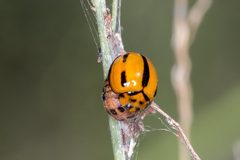
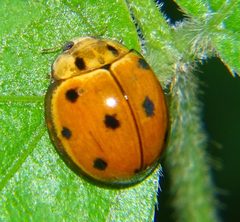
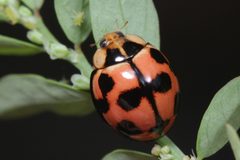
Pronunciation
How to pronounce Coelophora inaequalis: /sɛˈlɒfərə ɪnəˈkwɔːlɪs/
These audio files are automatically generated. While they are not always 100% accurate, they are a good starting point.
Identification
Distinguished from other Coelophora and Australian Coccinellidae by the combination of small size (under 5.5 mm), yellow pronotum with black basal marking, and highly variable spot patterns on yellow-orange . The 'variable' reflects this intraspecific , which can complicate identification. Coelophora inaequalis may be confused with other spotted ladybirds but is generally smaller than many Harmonia and lacks the consistent spot patterns of Coccinella septempunctata. Accurate identification may require examination of genitalia or larval .
Images
Appearance
are small ladybirds measuring 3.70–5.20 mm in length. The pronotum is yellow with a black area at the base. The are yellow to orange with four or five black spots, though spot number, size, and arrangement vary considerably among individuals. This gives rise to multiple color morphs including forms with elongated stripes, spots, zig-zag patterns, and heavy or reduced melanization. Larvae are described in taxonomic literature but specific descriptions require sources.
Habitat
Associated with vegetation supporting , including agricultural crops, orchards, and natural vegetation. In its native Australian range, found in diverse from coastal to inland areas. In introduced North American populations, established in sugarcane fields and other agricultural systems.
Distribution
Native to Australia, Oceania, and Southern Asia. Introduced and established in Florida and Hawaii, USA. GBIF records indicate presence in Australia, North America, Oceania, and parts of South America (Brazil: Alagoas, Paraíba, Pernambuco).
Seasonality
Activity patterns vary by region. In temperate and subtropical areas, likely active during warmer months when prey are abundant. Specific seasonal data from native range not well documented in available sources.
Diet
Primarily . Documented prey includes Aphis gossypii (cotton melon aphid), Aphis craccivora (cowpea aphid), and (). First instar larvae require aphid prey for successful development; later instars and can utilize alternative foods including pollen and lepidopteran (Corcyra cephalonica), though exclusive alternative diets support only limited survival and do not allow complete development.
Host Associations
- Aphis gossypii - preyessential prey for development
- Aphis craccivora - preydocumented prey under laboratory conditions
- Toxoptera citricida - preysupports complete in laboratory
- Sipha flava - target prey target in introduced range
- Corcyra cephalonica - alternative food can extend survival but not support development
- bee pollen - alternative foodcan supplement diet but insufficient as sole food source for larvae
Life Cycle
Complete with , four larval instars, pupa, and stages. Developmental period from egg to adult is temperature-dependent: approximately 15.9 days at 25°C and 24.7 days at 20°C when feeding on . stage is higher at 25°C (39.2%) than at 20°C (34.3%). Larvae are mobile . occurs on vegetation. Adults are relatively long-lived when provided with adequate prey.
Behavior
Larvae and are active exhibiting type II to , with search rate decreasing as handling time increases at higher prey densities. Fourth instar larvae have higher search rates (0.1305) but longer handling times (30.4 min) than adult females (search rate 0.0989, handling time 5.8 min). Adults and larvae are . Adults are capable of and .
Ecological Role
of aphids in agricultural and natural . Functions as a agent, with potential to suppress in crops including citrus, cotton, and sugarcane. linked to aphid prey availability.
Human Relevance
Used as a agent, introduced into Florida and Hawaii specifically to combat Sipha flava, the yellow sugarcane aphid. Studied extensively for its potential in programs. Not known to be a household pest or to have negative economic impacts.
Similar Taxa
- Harmonia axyridisSimilar size range and variable coloration, but H. axyridis is generally larger (5–8 mm), more domed, and typically shows a white pronotum with M-shaped or W-shaped black marking rather than yellow with black basal area.
- Coccinella septempunctataSimilar and prey use, but C. septempunctata has consistent seven-spot pattern on red , larger size (7–10 mm), and lacks the pronounced color of C. inaequalis.
- Coelophora spp. may overlap in distribution and appearance; accurate identification often requires examination of male genitalia or detailed larval .
More Details
Color pattern genetics
The extensive color is genetically controlled by a single locus with multiple showing mosaic dominance. Documented alleles include 'nine-spotted', 'elongated stripe', 'normal', '' (standard), 'zig-zag', 'black', 'yellow', and 'heavy'. Allele frequencies differ between Queensland and New South Wales .
Temperature and development
Laboratory studies demonstrate strong temperature effects on development rate and survival. Warmer temperatures (25°C vs. 20°C) significantly accelerate development and improve , suggesting climate warming may enhance growth in temperate regions.
Dietary limitations
Despite ability to consume alternative foods including pollen and , C. inaequalis is obligate for successful . First instar larvae cannot develop on alternative diets alone, and survive only 4–9 days on exclusive alternative foods.
Sources and further reading
- BugGuide
- Wikipedia
- GBIF taxonomy match
- iNaturalist taxon
- NCBI Taxonomy
- Bug Eric: Moth Monday: Palo Verde Webworm
- Eastern Larch Beetle Outbreak Keeps Going When Winter's Not So Cold
- Bug Eric: The Beetle and the Bee
- Spring sunshine heralds the appearance of plasterer bees: Colletes — Bug of the Week
- Spring arrives and with it, delightful Plasterer bees: Colletes spp. — Bug of the Week
- Bug of the Week
- Allelic Frequencies and Inheritance of Colour Pattern in Coelophora Inaequalis (F.) (Coleoptera: Coccinellidae).
- The Life History and Voracity of Coelophora inaequalis (Fabricus) (Coleoptera:Coccinellidae) on Aphis craccivora Koch (Hemiptera:Aphididae)
- Effect of Prey and Alternative Food Sources on Development and Reproduction of Coelophora inaequalis Fabricius (Coleoptera: Coccinellidae)
- Development and functional response of Coelophora inaequalis (Coleoptera: Coccinellidae) feeding on brown citrus aphid, Toxoptera citricida (Homoptera: Aphididae)
- Performance of each larval instar and adult of predaceous coccinellid Coelophora inaequalis (Fabricius) (Coleoptera, Coccinellidae) fed on natural prey and alternative foods
- LARVAE OF COELOPHORA INAEQUALIS (F.), PHRYNOCARIA GRATIOSA (MULSANT) AND P. ASTROLABIANA (WEISE) (COLEOPTERA: COCCINELLIDAE) WITH NOTES ON THEIR RELATIONSHIPS AND PREY RECORDS