
Anatis mali
(Say, 1824)
Eye-spotted Lady Beetle
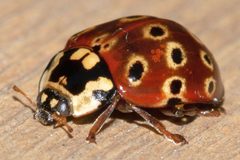
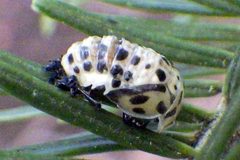
Anatis mali, commonly known as the -spotted lady beetle, is a North American lady beetle in the Coccinellidae. measure 7.3–10 mm in length and display variable coloration from yellow to brownish red with black markings. The species has been documented as a specialized of aphids in balsam fir plantations, where it plays a significant role in . Research indicates that larvae require approximately 296 aphids to complete development and pupate.
Pronunciation
How to pronounce Anatis mali: /ˈæn.ə.tɪs ˈmeɪ.laɪ/
These audio files are automatically generated. While they are not always 100% accurate, they are a good starting point.
Identification
Distinguished from other lady beetles by its larger size (7.3–10 mm) compared to many common Coccinellidae, and by its specific color pattern of yellow to brownish red with black markings. The name 'mali' and '-spotted' suggest the presence of distinctive eye-like spots, though specific spot patterns require verification from diagnostic sources.
Images
Appearance
reach 7.3–10 mm in length. Coloration ranges from yellow to brownish red with black markings. The specific pattern and arrangement of these markings distinguish it from other Anatis .
Habitat
Associated with balsam fir (Abies balsamea) plantations and coniferous forest systems. Occurs in supporting on coniferous trees.
Distribution
North America, recorded from Ontario to British Columbia in Canada, south to Virginia and Oregon in the United States. Specific provincial and state records include Alberta, British Columbia, and Manitoba in Canada.
Diet
Specialized . Larvae have been observed to require approximately 296 aphids to complete larval development and . Specifically associated with aphid prey in balsam fir plantation systems.
Host Associations
- Abies balsamea - Balsam fir plantation system where the functions as a agent
Life Cycle
Complete with , larva, pupa, and stages. Larval development requires substantial prey consumption (approximately 296 aphids) before .
Ecological Role
of aphids in coniferous forest , particularly balsam fir plantations. Identified as a crucial specialized predator in Christmas tree production systems. Considered to have significant potential for biological management applications on pre-harvest trees where visual damage is not a primary concern.
Human Relevance
Evaluated for use in biological pest management in balsam fir Christmas tree plantations. Considered valuable for controlling in pre-harvest trees where aesthetic damage is not critical. Not known to be a pest or nuisance to humans.
Similar Taxa
- Anatis leconteiLarger congeneric lady beetle found in western North America, distinguished by size and specific spot pattern
- Anatis labiculataAnother North American Anatis with which it may be confused; requires examination of coloration and spot arrangement for separation
More Details
Biological Control Research
Studies have demonstrated the ' potential for in Christmas tree production, with particular emphasis on its as an in the ten-year balsam fir cycle.
Rearing Requirements
Laboratory rearing studies have established quantitative prey requirements, with individual larvae consuming an average of 296 aphids to reach .
Sources and further reading
- BugGuide
- Wikipedia
- GBIF taxonomy match
- iNaturalist taxon
- NCBI Taxonomy
- Cindy Kron: Adventures of the North Coast Area Extension Entomologist | Bug Squad
- Bug Eric: Blodgett Peak Bioblitz Report
- habitat preservation | Blog
- A non-black background is better… often! | Beetles In The Bush
- Advances in Sterile Insect Technique Driven by Sugarcane Pest Management in South Africa
- Taxon Expeditions | Blog