
Anatis
Giant Lady Beetles
Species Guides
4- Anatis labiculata(Fifteen-spotted Lady Beetle)
- Anatis lecontei(LeConte's Giant Lady Beetle)
- Anatis mali(Eye-spotted Lady Beetle)
- Anatis rathvoni(Flying Saucer Lady Beetle)
Anatis is a of ladybird beetles (Coccinellidae) commonly known as "giant lady beetles." The genus contains approximately ten extant distributed primarily in North America, with at least two fossil species described. Members are relatively large compared to most lady beetles and are predatory as and larvae. The genus includes notable species such as Anatis mali and Anatis labiculata, which have been studied for their potential.
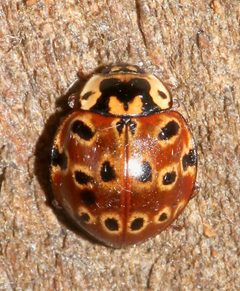
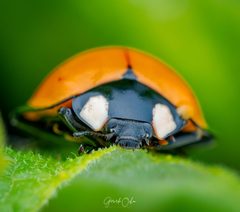
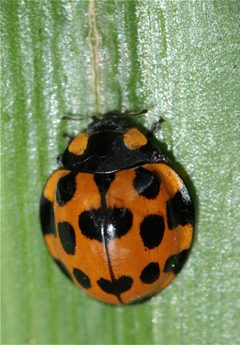
Pronunciation
How to pronounce Anatis: /əˈneɪtɪs/
These audio files are automatically generated. While they are not always 100% accurate, they are a good starting point.
Identification
Large body size distinguishes Anatis from most other Coccinellidae ; typically exceed 7 mm in length. within the genus can be differentiated by elytral pattern: A. labiculata has fifteen black spots on reddish-orange , A. mali has variable spotting with some individuals nearly solid black, and A. lecontei shows distinct pale lateral margins on dark elytra. The pronotum is relatively broad with patterns that vary among species.
Images
Habitat
Found in arboreal including deciduous and coniferous forests, orchards, and wooded riparian corridors. Associated with trees and shrubs where prey occur.
Distribution
Primarily North American; occur across Canada, the United States, and Mexico. Individual species ranges vary: A. labiculata is transcontinental in North America, A. mali occurs in eastern and central regions, and A. lecontei is documented in western montane areas including Colorado foothills.
Diet
Predatory on aphids and other small soft-bodied insects; specific prey associations vary by and season.
Ecological Role
Predatory beetles contributing to of in forest, orchard, and agricultural .
Human Relevance
Some , particularly Anatis mali and A. labiculata, have been evaluated or utilized for biological pest control in orchards and forests. No significant negative impacts on humans are documented.
Similar Taxa
- CoccinellaBoth are spotted lady beetles, but Anatis are generally larger (often >7 mm vs. 5-7 mm) and have proportionally broader, more rounded .
- HippodamiaSimilar size range and overlap, but Hippodamia typically have more elongated body shape and different spot arrangements; Anatis has a more convex, rounded profile.
Sources and further reading
- BugGuide
- Wikipedia
- iNaturalist taxon
- NCBI Taxonomy
- Catalogue of Life
- Bug Eric: Blodgett Peak Bioblitz Report
- runting of ducklings and turkeys associated with cochlosoma anatis
- A case of human diarrhea caused by Gallibacterium anatis: a case report
- Runting of Ducklings Associated with Cochlosoma anatis Infection