
Trirhabda flavolimbata
(Mannerheim, 1843)
Coyote Brush Leaf Beetle
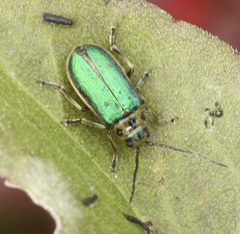
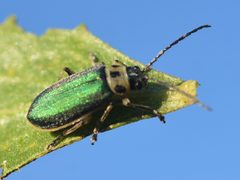
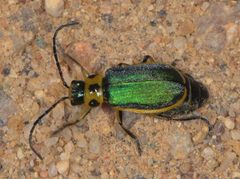
Trirhabda flavolimbata, commonly called the coyote brush , is a skeletonizing leaf beetle in the Chrysomelidae. It is restricted to California where it inhabits coastal scrublands and chaparral. Both larvae and are metallic green and sequester toxins from their plants, rendering them unpalatable to . The has a single with a distinctive involving extended .
Pronunciation
How to pronounce Trirhabda flavolimbata: /tɹɪˈɹæbdə flævoʊˈlɪmbətə/
These audio files are automatically generated. While they are not always 100% accurate, they are a good starting point.
Identification
Metallic green coloration in both larvae and distinguishes this from many other leaf beetles. The uniform metallic green appearance, combined with association with coyote brush (Baccharis pilularis) in California coastal , provides strong field identification cues. Adults active in spring (April–May) can be distinguished from the preceding larval stage by their fully developed wings and -like form.
Images
Habitat
Coastal scrublands and chaparral in California. Specifically associated with stands of coyote brush and related vegetation.
Distribution
to California, North America. Records concentrated in coastal regions where coyote brush occurs.
Seasonality
Larvae active February to March; active April to May. laid in soil undergo extended , remaining unhatched over summer and winter before hatching the following year.
Diet
Main plant is coyote brush (Baccharis pilularis). Has been observed feeding on other Baccharis , as well as Aster, Senecio, Artemisia, Solidago, and Eriodictyon.
Host Associations
- Baccharis pilularis - primary Main plant; source of sequestered defensive compounds
- Baccharis - Other in also used
- Aster - Observed feeding
- Senecio - Observed feeding
- Artemisia - Observed feeding
- Solidago - Observed feeding
- Eriodictyon - Observed feeding
Life Cycle
One per year (). are laid in soil where they remain through summer and winter, hatching the following year. Larvae feed voraciously on plants February–March, then return to soil to pupate for approximately two weeks. emerge and are active April–May.
Behavior
Larvae feed openly on leaves, skeletonizing plant foliage. Both life stages are toxic due to of chemicals from coyote brush, and their metallic green coloration likely serves as aposematic warning signals to .
Ecological Role
Herbivore that can cause substantial defoliation of coyote brush. The of plant toxins creates a chemically defended herbivore that may influence –prey dynamics in coastal scrub . could potentially alter vegetation structure, though this has been less studied than in related Trirhabda .
Human Relevance
No significant direct economic impact. Of ecological interest due to its specialized relationship and chemical defense strategy. May serve as a biological indicator for healthy coastal scrub and chaparral .
Similar Taxa
- Trirhabda bacharidusAlso feeds on Baccharis ; distinguished by distribution (Florida and southeastern US versus California) and subtle morphological differences in coloration and markings.
- Other Trirhabda speciesMany Trirhabda are specialized on Asteraceae and share similar body plans; T. flavolimbata is distinguished by its California , metallic green coloration in all life stages, and specific association with coyote brush.
More Details
Chemical Defense
The of both larvae and is derived from of compounds ingested from coyote brush (Baccharis pilularis), which contains defensive chemicals including terpenoids and flavonoids.
Taxonomic Note
The specific epithet 'flavolimbata' (meaning 'yellow-bordered') appears inconsistent with the described metallic green coloration; this may reflect historical characteristics or variation not evident in usage.