
Bromius obscurus
(Linnaeus, 1758)
Western Grape Rootworm, Brown and Black Beetle
Bromius obscurus is a small leaf beetle (Chrysomelidae: Eumolpinae) and the sole member of its . It is a Holarctic with a notable geographic pattern: North American reproduce sexually while European populations are triploid and reproduce asexually. The species is recognized as a pest of grape vines in Europe and western North America. possess a stridulatory apparatus on the wings, the first documented in the Eumolpinae.
Pronunciation
How to pronounce Bromius obscurus: /ˈbroʊ.mi.əs əbˈskjʊər.əs/
These audio files are automatically generated. While they are not always 100% accurate, they are a good starting point.
Identification
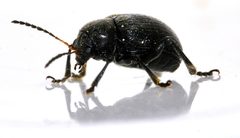
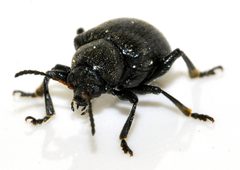
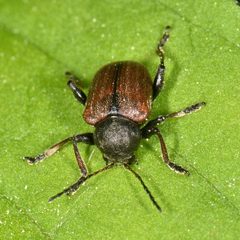
Distinguished from other small Chrysomelidae by the combination of orange-red basal antennal segments and dull yellow-grey on a dark body. The stridulatory apparatus on the wings is unique among Eumolpinae. Variations with brown (var. epilobii, var. villosulus) may be confused with Aoria rufotestacea; Korean specimens historically misidentified as B. obscurus were found to be A. rufotestacea. The typical black form with whitish hairs is most readily recognized.
Images
Habitat
Associated with grape areas and broader woodland and shrubland environments. Specific microhabitat preferences vary by geographic region.
Distribution
Holarctic distribution: North America (Canada south to North Carolina in the east and California in the west), wide parts of Europe, and Asia including northern Siberia. In the United Kingdom, currently known only from a single site in Scotland; historically recorded from Cheshire/Staffordshire border but not seen since 1992. Fossil records from late Pleistocene deposits in northeastern Russia.
Diet
Herbivorous; leaves and other plant parts. Known pest of grape vines (Vitis spp.) in Europe and western North America.
Host Associations
- Vitis spp. - pestGrape vines; primary economic in Europe and western North America
Life Cycle
Larval development occurs in soil, feeding on roots. Specific details of , larval instars, and not documented in available sources.
Behavior
Geographic : North American reproduce sexually, while European populations reproduce asexually via parthenogenesis and are triploid. possess a stridulatory apparatus on the upper sides of the wings, producing sound through a darkened convex microstructure spot near the wing apex.
Ecological Role
Herbivore; root-feeding larvae may influence plant health in natural and cultivated systems. Symbiotic relationship with specialized Gammaproteobacteria bacteria housed in gut symbiotic organs and transmitted vertically through female genital accessory organs.
Human Relevance
Agricultural pest of grape vines, causing economic damage in European and western North American vineyards. The name commemorates Bromius, an epithet of Dionysus, the Greek god of wine—an etymological nod to its association with viticulture.
Similar Taxa
- Aoria rufotestaceaSuperficially similar to the villosulus variation of B. obscurus; historically confused in Korean specimens until 2014 molecular and morphological clarification
- Trichochrysea hirtaFormerly placed in Bromius (as Eumolpus hirtus) but now classified in separate ; historical taxonomic confusion
Misconceptions
The name 'obscurus' has led to confusion with other beetles bearing similar epithets, such as Dicerca obscura (Buprestidae) and various Aphytis , which are unrelated in different .
More Details
Symbiotic Bacteria
Possesses specialized gut symbiotic organs surrounding the - junction that harbor endocellular Gammaproteobacteria. Females have paired genital accessory organs for of to offspring. The symbiont shows reductive evolution with accelerated molecular evolution and AT-biased composition.
Taxonomic Nomenclature
The generic name Bromius Chevrolat, 1836 is a conserved name following a 2012 ICZN ruling that suppressed Eumolpus Illiger, 1798. The was historically also known as Adoxus Kirby, 1837, now a synonym.
Known Variations
Four described variations: typical form ( black, whitish hairs); var. weisei (black elytra, yellowish hairs, basally reddish-brown tibiae); var. epilobii (brown elytra and tibiae, whitish hairs); var. villosulus (brown elytra, yellowish hairs). Status as variations versus remains unsettled among authors.
Sources and further reading
- BugGuide
- Wikipedia
- GBIF taxonomy match
- iNaturalist taxon
- NCBI Taxonomy
- Aphytis Project Final Report | Entomology Research Museum
- Bug Eric: Year-end Wrap-up
- The “obscure” Dicerca | Beetles In The Bush
- Symbiotic bacteria associated with gut symbiotic organs and female genital accessory organs of the leaf beetle Bromius obscurus (Coleoptera: Chrysomelidae)