
Bromius
Chevrolat in Dejean, 1836
Species Guides
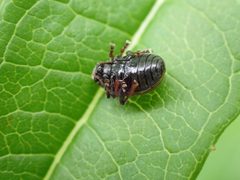
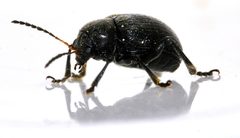
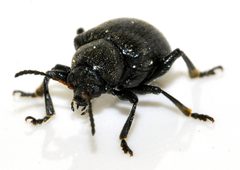
1- Bromius obscurus(Western Grape Rootworm)
Bromius is a of leaf beetles in the Chrysomelidae, Eumolpinae, tribe Bromiini. The genus is characterized by intimate associations with bacterial housed in specialized gut organs and female genital accessory organs. The type , Bromius obscurus, has been studied for its unique of Gammaproteobacteria symbionts. The genus occurs across northern Europe and has been introduced to North America.
Pronunciation
How to pronounce Bromius: /ˈbroʊ.mi.əs/
These audio files are automatically generated. While they are not always 100% accurate, they are a good starting point.
Identification
Members of Bromius can be distinguished from related eumolpine by the presence of specialized gut-associated symbiotic organs surrounding the - junction. These organs contain endocellular bacteria in small rosette-like or aggregated -like formations. Female genital accessory organs harbor extracellular in condensed form, a trait used to differentiate Bromius obscurus from morphologically similar .
Images
Distribution
Northern Europe (Denmark, Norway, Sweden) and introduced to North America (Vermont, United States).
Diet
Herbivorous; feeds on leaves and other plant parts.
Host Associations
- Gammaproteobacteria - Distinct bacterial lineage housed in gut symbiotic organs and female genital accessory organs; transmitted vertically via female genital organs. shows reductive evolution with accelerated molecular evolution and AT-biased composition.
Life Cycle
of bacterial occurs via female genital accessory organs to offspring.
Similar Taxa
- Tabanus bromiusDifferent ; Tabanus bromius is a horsefly (Diptera: Tabanidae), not a leaf beetle. The shared specific epithet 'bromius' creates potential confusion, but the belong to entirely different orders and have no close relationship.
More Details
Etymology
The name derives from 'Bromius', an epithet of Dionysus/Bacchus in ancient Greek mythology, meaning 'noisy', 'roaring', or 'boisterous' (from βρέμειν, to roar). This name was applied by Chevrolat in 1836.
Sources and further reading
- BugGuide
- Wikipedia
- GBIF taxonomy match
- iNaturalist taxon
- NCBI Taxonomy
- Catalogue of Life
- Feeding strategies of the horseflies Hybomitra expollicata and Tabanus bromius in southern France
- Symbiotic bacteria associated with gut symbiotic organs and female genital accessory organs of the leaf beetle Bromius obscurus (Coleoptera: Chrysomelidae)