
Donacia pubescens
LeConte, 1868
Pubescent sedge beetle
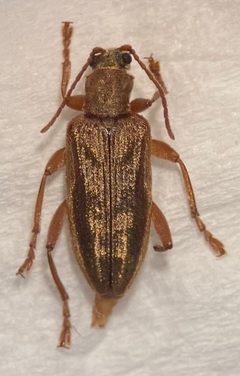
Donacia pubescens is an aquatic leaf beetle in the Chrysomelidae, first described by LeConte in 1868. It is found across North America, with records from Canada (Alberta, British Columbia, Manitoba) and the United States. Like other members of the Donacia, it is associated with aquatic and is likely a on aquatic plants.
Pronunciation
How to pronounce Donacia pubescens: /dɔˈna.si.a puˈbɛs.kɛns/
These audio files are automatically generated. While they are not always 100% accurate, they are a good starting point.
Identification
A medium-sized Donacia distinguished by its pubescent (hairy) body surface. Members of Donacia can be recognized by their elongated, somewhat flattened bodies adapted for aquatic life, with the hind enlarged for swimming. D. pubescens specifically differs from by its denser . Final identification requires examination of genitalia and comparison with closely related species.
Images
Habitat
Aquatic and semi-aquatic environments, including ponds, lakes, and slow-moving waters with emergent vegetation. Associated with sedges and other aquatic plants.
Distribution
North America. Canadian provinces: Alberta, British Columbia, Manitoba. Also present in the United States, though specific state records are limited in available sources.
Host Associations
- sedges - probable Donacia strongly associated with Cyperaceae and other aquatic plants; specific for D. pubescens not confirmed
Behavior
are active swimmers and fliers, capable of moving between water bodies. Like other Donacia , they likely lay on aquatic plant stems; larvae are aquatic and feed internally on plant tissues, using a modified respiratory siphon to obtain air from the plant surface.
Ecological Role
Herbivore in aquatic , potentially affecting growth of aquatic vegetation. Larval feeding inside plant stems may influence plant and structure in wetland .
Similar Taxa
- Donacia cincticornisSimilar aquatic and appearance; distinguished by antennal and characteristics
- Donacia piscatrixOverlapping distribution and ; requires careful examination of body and genitalia for separation
More Details
Taxonomic history
Described by John Lawrence LeConte in 1868, a prolific American entomologist who described thousands of . The specific epithet 'pubescens' refers to the hairy body surface that distinguishes this species.
Conservation status
Not formally assessed; appears to be naturally uncommon based on limited observation records (10 observations on iNaturalist as of source date).
Sources and further reading
- BugGuide
- Wikipedia
- GBIF taxonomy match
- iNaturalist taxon
- August | 2021 | Beetles In The Bush
- Northern Ireland, invertebrate finds in review 2023 - Buglife Blog - Buglife
- Botanizing at Hawn State Park | Beetles In The Bush
- Missouri | Beetles In The Bush | Page 6
- Ericaceae | Beetles In The Bush
- May | 2016 | Beetles In The Bush