
Oulema melanopus
(Linnaeus, 1758)
cereal leaf beetle
is a leaf beetle native to Eurasia that was introduced to North America in 1962, where it has since become a significant economic pest of small grain crops. The is particularly damaging to spring wheat and oats, with that are sporadic and difficult to predict. Larval feeding causes the most damage by skeletonizing leaves. Management relies on , though using introduced and breeding programs offer promising alternatives.
Pronunciation
How to pronounce Oulema melanopus: /ˈuː.lɛ.mə mɛˈlæ.nə.pəs/
These audio files are automatically generated. While they are not always 100% accurate, they are a good starting point.
Identification
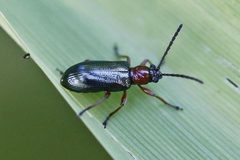
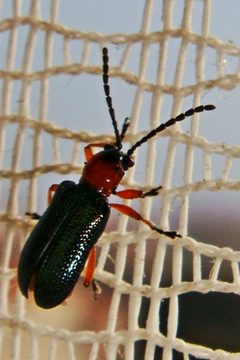
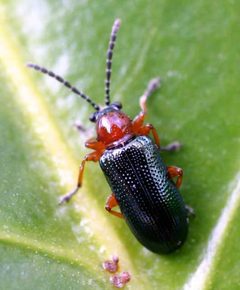
are small beetles approximately 4-5 mm in length with metallic blue-black and reddish-orange legs and . Larvae are distinctive: yellowish, soft-bodied, and covered with a dark, slimy coating of their own excrement, giving them a slug-like appearance. This larval habit of carrying fecal material is diagnostic for the . Adults can be distinguished from similar Oulema species by the combination of metallic elytra and orange appendages.
Images
Habitat
Agricultural dominated by small grain cereals; particularly abundant in spring wheat and oat fields. The thrives in temperate cereal-growing regions with adequate moisture. Winter wheat fields support lower compared to spring-planted grains.
Distribution
Native to Eurasia, with established across Europe, northern Africa, the Middle East, and Asia. Introduced to North America in 1962 (first detected in Michigan, USA); now established across the northern United States and southeastern Canada. The continues to expand its range in North America.
Seasonality
emerge in spring and are active during the cereal growing season. laying coincides with crop development. Larval development occurs through late spring and early summer. occurs in soil. There is typically one per year in temperate regions, with adults in sheltered locations.
Diet
and larvae feed on leaves of small grain cereals, particularly wheat (Triticum aestivum), oats (Avena sativa), and barley (Hordeum vulgare). Larvae are the primary damaging stage, skeletonizing leaves by consuming tissue between . Adults cause minor feeding damage compared to larvae.
Host Associations
- Triticum aestivum - primary spring wheat most susceptible
- Avena sativa - primary oats support high larval densities with -dependent mortality
- Hordeum vulgare - varietal resistance documented
- various grasses - alternate wild grasses support
Life Cycle
Holometabolous with four life stages: , larva, pupa, . Eggs are laid singly or in small groups on leaves and stems. Larvae pass through four instars, with first instar establishment on oats becoming increasingly difficult at high densities due to leaf surface disturbance. Fourth instar mortality increases with due to food competition. occurs in earthen in the soil. Adults overwinter in protected sites. Typically one per year.
Behavior
Larvae exhibit a characteristic defensive of covering themselves with dark, slimy excrement, presumably for protection from and desiccation. are capable of and disperse to find new patches. are strongly regulated by intraspecific -dependent competition, particularly among larvae. are sporadic and unpredictable in occurrence.
Ecological Role
Herbivore in agricultural ; significant consumer of cereal leaf . Serves as for introduced agents, particularly the larval Tetrastichus julis. can substantially reduce primary productivity of cereal crops.
Human Relevance
Major economic pest of small grain agriculture in the northern hemisphere. Larval feeding reduces photosynthetic capacity and grain yields. Management costs include applications and agent establishment. The has been the target of programs using European . Breeding programs have developed barley and wheat varieties.
Similar Taxa
- Oulema duftschmidiSimilar appearance and ; distinguished by subtle morphological differences in male genitalia and elytral punctation
- Oulema gallaecianaOverlapping distribution and use; requires examination of structure for definitive identification
- other Chrysomelidae leaf beetlesO. melanopus distinguished by the characteristic larval habit of carrying fecal coating, plus association with cereal crops
Sources and further reading
- BugGuide
- GBIF taxonomy match
- iNaturalist taxon
- NCBI Taxonomy
- Grasshoppers of Colorado
- Cereal leaf beetle (Oulema melanopus)
- Oulema melanopus . [Distribution map].
- The Cereal Leaf Beetle Today (Oulema melanopus L.)
- Life History and Host Preferences of Tetrastichus Julis (Walker) (Hymenoptera: Eulophidae), the Principal Parasitoid of the Cereal Leaf Beetle, Oulema Melanopus (L.) (Coleoptera: Chrysomelidae)
- Simulation model of Oulema melanopus in the winter‐wheat ecosystem1
- Spatial Distribution of Cereal Leaf Beetle (Oulema melanopus (L)) 1 Eggs and Larvae and Treatment of Count Data 2
- POPULATION DYNAMICS OF THE CEREAL LEAF BEETLE, OULEMA MELANOPUS (COLEOPTERA: CHRYSOMELIDAE): A MODEL FOR AGE SPECIFIC MORTALITY
- Resistance of Barley (Hordeum vulgare L. Emend. Lam.) Cereal Leaf Beetle (Oulema melanopus L.)1
- Impact of climate change on potential distributions and relative abundances of Oulema melanopus, Meligethes viridescens and Ceutorhynchus obstrictus in Canada