
Paropsisterna
Motschulsky, 1860
leaf beetles, eucalyptus leaf beetles
Species Guides
1- Paropsisterna m-fuscum(Eucalyptus Leaf Beetle)
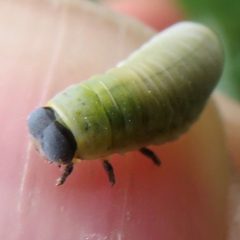
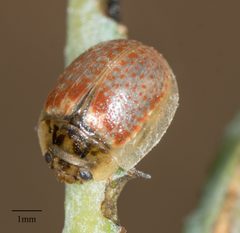
Paropsisterna is a of chrysomelid leaf beetles containing over 120 native to Australia and Papua New Guinea. Many species exhibit bright aposematic coloration and feed on Myrtaceae, particularly Eucalyptus. Several species have become pests in New Zealand and Europe, causing significant defoliation of eucalypt plantations and ornamental trees. The genus was redefined in 2006 to include species formerly placed in Chrysophtharta and other genera.
Pronunciation
How to pronounce Paropsisterna: //ˌpɑːrɒpˈsɪstɜrnə//
These audio files are automatically generated. While they are not always 100% accurate, they are a good starting point.
Identification
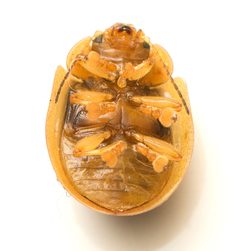
Distinguished from related paropsine by the combination of: open procoxal cavity with gap at least half the procoxa width; mid and hind tibiae with at least one sharp external longitudinal keel; maxillary palpomere strongly expanded from base to apex; and frontoclypeal rounded or V-shaped without lateral ridges. The broadest point of the pronotum at its base also aids separation from some . -level identification requires examination of genitalia and color pattern.
Images
Appearance
Beetles 3-17 mm in length with semicircular to elongate-ovate bodies that are moderately to strongly convex. The frontoclypeal is rounded or V-shaped and lacks lateral ridges. The maxillary palpomere is strongly expanded from base to apex. The pronotum is broadest at its base. The procoxal cavity is open with a gap at least half the width of the procoxa. Mid and hind tibiae possess at least one sharp external longitudinal keel. Tarsal claws are usually acutely toothed, rarely simple. Many display bright aposematic colors that may fade after death.
Habitat
Primarily eucalypt forests and woodlands in native range; plantations and ornamental plantings of Myrtaceae in introduced ranges. Associated with plants in Myrtaceae including Eucalyptus, Melaleuca, Leptospermum, and related .
Distribution
Native to Australia and Papua New Guinea. Multiple introduced to New Zealand (including P. cloelia, P. selmani, P. variicollis), with P. selmani also established in Ireland and the United Kingdom. Some species have potential for further spread in Europe.
Seasonality
of at least some overwinter in soil and emerge in spring (April in Ireland for P. selmani). adults most noticeable in late June and July. Activity patterns vary by species and climate.
Diet
Folivory on Myrtaceae. Recorded include Eucalyptus, Acmena, Agonis, Angophora, Baeckea, Callistemon, Darwinia, Kunzea, Leptospermum, and Melaleuca. Records from Acacia (Fabaceae) are considered likely erroneous. Larvae and feed on foliage; some feed preferentially on new flush foliage, others on both and adult leaves of heteroblastic eucalypts.
Host Associations
- Eucalyptus - primary majority of ; some are pests
- Melaleuca - P. tigrina proposed as biocontrol agent for M. quinquenervia in Florida
- Leptospermum -
- Kunzea -
- Callistemon -
- Angophora -
- Acmena -
- Agonis -
- Baeckea -
- Darwinia -
Life Cycle
Complete with , larval, pupal, and stages. Eggs laid in batches on leaves (approximately 7 eggs per batch in P. selmani). completed in approximately 26 days at 20°C in P. selmani. Survival rates approximately 67% when fed on E. parvula. adults take approximately 13 days to initiate egg-laying. Mean daily egg-laying rate of 11.4 eggs per female over 130 days recorded for P. selmani.
Behavior
overwinter in soil and emerge in spring. Both larvae and adults feed on foliage, causing typical 'broom-top' damage to trees. Some exhibit preferences for particular Eucalyptus sections within subgenus Symphyomyrtus. Larvae of some species feed on both flush and adult leaves of heteroblastic eucalypts.
Ecological Role
Native herbivores in Australian ; significant defoliators of Myrtaceae. In introduced ranges, pests causing economic damage to forestry and ornamental industries. Serve as for specialized (Pteromalidae: Enoggera nassaui, Neopolycystus insectifurax) and including coccinellid beetles, pentatomid , lacewings, and spiders.
Human Relevance
Several are major forestry pests: P. agricola, P. bimaculata, P. m-fuscum, P. obovata, and P. variicollis on various Eucalyptus species; P. selmani in Ireland and UK causing damage to cut-foliage and forestry industries. P. tigrina proposed as agent for invasive Melaleuca quinquenervia in Florida. strategies include breeding for resistance, biological control, and application.
Similar Taxa
- ParopsisBoth are paropsine leaf beetles with similar and ; Paropsis generally lack the expanded maxillary palpomere and have different pronotal and tibial characteristics
- ChrysophthartaFormerly recognized as separate ; now synonymized under Paropsisterna based on phylogenetic and morphological studies in 2006
More Details
Taxonomic History
The was described by Victor Motschulsky in 1860. In 2006, Paropsisterna was expanded to include formerly placed in Chrysophtharta Weise, 1901, Niliosoma Motschulsky, Sterromela Weise, and Xanthogramma Weise. This reclassification significantly increased the number of recognized species to over 120.
Invasive Potential
Multiple have established outside native range: P. cloelia in New Zealand (2016), P. selmani in Ireland and UK (origin likely Tasmania), and P. variicollis in New Zealand (2016). Climate modeling suggests P. cloelia will spread throughout New Zealand and potentially has higher reproductive output and survival than the established pest P. charybdis.
Biological Control Challenges
Established Enoggera nassaui and Neopolycystus insectifurax in New Zealand strongly prefer P. charybdis over P. cloelia, with 32-79% of P. cloelia eggs remaining unparasitized versus 1-24% for P. charybdis. Offspring emerging from P. cloelia eggs are 36% smaller, indicating lower quality. Oechalia schellenbergii (Pentatomidae) and Cleobora mellyi (Coccinellidae) show promise for augmentative biocontrol.
Sources and further reading
- BugGuide
- Wikipedia
- GBIF taxonomy match
- iNaturalist taxon
- NCBI Taxonomy
- Established Paropsis charybdis egg parasitoids are unlikely to control the newly invaded Paropsisterna cloelia (both Coleoptera: Chrysomelidae) in New Zealand
- Predators of the two paropsine leaf beetles Paropsisterna cloelia and Paropsis charybdis in eucalypt plantations in Marlborough, New Zealand
- Biology of the Eucalyptus leaf beetle Paropsisterna selmani ( C hrysomelidae: P aropsini): a new pest of Eucalyptus species ( M yrtaceae) in I reland
- Incidence of and defoliation by a newly introduced pest, <i>Paropsisterna variicollis</i> (Coleoptera: Chrysomelidae), on eleven durable <i>Eucalyptus</i> species in Hawke’s Bay, New Zealand
- Comparison of the biology, ecology and potential pest impacts of the eucalypt-defoliating leaf beetles <i>Paropsisterna cloelia</i> and <i>Paropsis charybdis</i> (Coleoptera: Chrysomelidae) in New Zealand