
Paropsis
G.-A. Olivier, 1807
tortoise beetles
Species Guides
1- Paropsis atomaria(Dotted Paropsine Leaf Beetle)
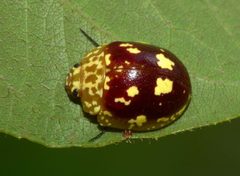
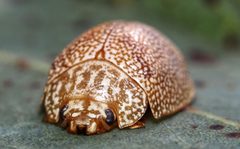
Paropsis is a of leaf beetles (Chrysomelidae) comprising over 70 described . Members are small, brightly colored, and hemispherical in shape, leading to frequent misidentification as ladybirds (Coccinellidae). The genus is native to Australasia and has become established in some regions outside its native range through accidental introduction. Several species are significant defoliators of Eucalyptus and are considered economic pests in forestry plantations.
Pronunciation
How to pronounce Paropsis: /pəˈrɒpsɪs/
These audio files are automatically generated. While they are not always 100% accurate, they are a good starting point.
Identification
Paropsis are distinguished from similar beetles by their hemispherical, tortoise-like body shape and the structure of their . They differ from Coccinellidae (ladybirds) in having a more flattened, less domed profile and different antennal structure. Species-level identification requires examination of genitalia and detailed morphological features; the is part of the paropsine leaf beetles, which share a characteristic broadly oval body form and association with Myrtaceae .
Images
Habitat
Eucalypt forests and woodlands; also found in vegetation dominated by other Myrtaceae including Baeckea, Kunzea, and Leptospermum. In New Zealand, established occur in Eucalyptus plantations.
Distribution
Native to Australia, New Zealand, and Papua New Guinea. Paropsis atomaria has been introduced to California, United States, with first documented sightings in 2022.
Seasonality
In the Australian Capital Territory, Paropsis atomaria completes two annually. emerging in autumn enter reproductive in response to shortening day-length and hibernate through winter in litter and soil beneath trees. Spring and summer activity corresponds with -laying and larval development on new host growth.
Diet
Primarily folivorous on Eucalyptus. Some feed on Baeckea, Kunzea, and Leptospermum.
Host Associations
- Eucalyptus - primary preferred for most
- Baeckea - recorded for some
- Kunzea - recorded for some
- Leptospermum - recorded for some
Life Cycle
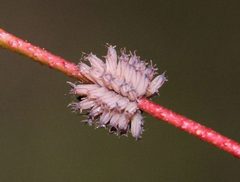
Paropsis atomaria has four larval instars. are laid in batches on young shoots. Larvae are highly gregarious throughout all instars. occurs in soil beneath trees. Development rate is temperature-dependent; final larval weight depends on foliage quality. Larval growth follows a geometric pattern except during the first instar and final days of the fourth instar.
Behavior
of Paropsis atomaria are capable of over considerable distances but females tend to oviposit on the first suitable tree encountered after from soil or litter. Larvae exhibit strong gregarious in all four instars. Adults enter reproductive in autumn in response to shortening .
Ecological Role
Defoliator of eucalypts and other Myrtaceae. Can reach pest levels in plantations. Serves as for diverse including braconids (Eadya spp.), tachinid flies, and pteromalid wasps.
Human Relevance
Several are economic pests of Eucalyptus forestry. Paropsis charybdis is the most serious pest of Eucalyptus in New Zealand. Paropsis atomaria has been introduced to California and has potential to impact eucalypt plantings there. The has been the target of programs, with such as Enoggera nassaui and Cleobora mellyi introduced to New Zealand.
Similar Taxa
- Paropsisternacongeneric leaf beetles in the same tribe (Paropsini) with similar and associations; distinguished by subtle differences in elytral punctation and genitalia
- Coccinellidaefrequently mistaken due to similar small size, bright coloration, and hemispherical shape; distinguished by body profile, antennal structure, and tarsal formula
Sources and further reading
- BugGuide
- Wikipedia
- iNaturalist taxon
- NCBI Taxonomy
- Catalogue of Life
- Journal of Hymenoptera Research 64th issue | Blog
- Ecological characteristics of the eucalypt-defoliating chrysomelid Paropsis atomaria Ol.
- NOTES ON THE BIOLOGY OFPAROPSIS CHARYBDISSTAL (COLEOPTERA : CHRYSOMELIDAE)
- Aspects of the Biology of the Eucalypt-Defoliating Chrysomelid Beetle Paropsis Atomaria Ol. In the Australian Capital Territory.
- <i>Paropsis charybdis</i> defoliation of <i>Eucalyptus</i> stands in New Zealands central North Island
- The seasonal abundance of the newly established parasitoid complex of the Eucalyptus tortoise beetle (<i>Paropsis charybdis</i>)
- Description of four new species of Eadya (Hymenoptera, Braconidae), parasitoids of the Eucalyptus Tortoise Beetle (Paropsis charybdis) and other Eucalyptus defoliating leaf beetles
- Distribution and current status of natural enemies of <i>Paropsis charybdis</i> in New Zealand
- GROWTH AND FOOD CONSUMPTION DURING THE LARVAL STAGES OF PAROPSIS ATOMARIA (COLEOPTERA: CHRYSOMELIDAE)
- Natural enemies of Paropsis atomaria Olivier (Coleoptera: Chrysomelidae) in south‐eastern Queensland eucalypt plantations
- Effects of Ddt and Fenitrothion on Field-Collected Larvae of a Eucalypt-Defoliating Beetle, Paropsis Atomaria Ol. Ii. Effects of Treatment of the Host on the Parasitoids.