
Zygogramma
Chevrolat in Dejean, 1836
Species Guides
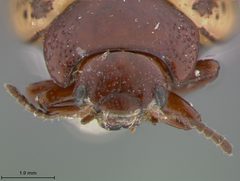
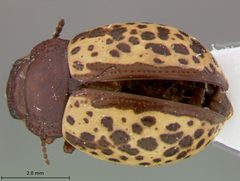
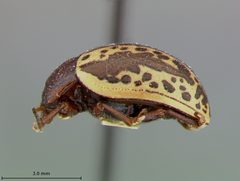
13Zygogramma is a large of leaf beetles in the Chrysomelinae, comprising approximately 100 with 13 species occurring north of Mexico. The genus is characterized by its association with plants in the Asteraceae, particularly ragweeds (Ambrosia) and related genera. Several species, especially Z. bicolorata, have been extensively studied and deployed as agents against weeds. The genus is distinguished from related genera such as Calligrapha by tarsal claws.
Pronunciation
How to pronounce Zygogramma: /zaɪɡoʊˈɡræmə/
These audio files are automatically generated. While they are not always 100% accurate, they are a good starting point.
Identification
Members of Zygogramma can be distinguished from the similar Calligrapha by having tarsal claws that are joined at the base (), whereas Calligrapha has tarsal claws that are separate. The genus exhibits vittate (striped) coloration patterns similar to some Calligrapha , with typically showing yellow or reddish ground color with black markings. Species-level identification often requires examination of genitalia or knowledge of plant associations.
Images
Habitat
Associated with herbaceous vegetation in natural and agricultural . occur in supporting their plants in the Asteraceae , including disturbed areas, roadsides, and agricultural fields.
Distribution
occurs in the Americas with highest diversity in the Neotropics. Eight recorded from Argentina. In North America, 13 species occur north of Mexico. Z. bicolorata has been introduced to Australia, India, South Africa, Ethiopia, and Uganda for .
Diet
Herbivorous; larvae and feed on leaves of plants. Z. bicolorata is a leaf-feeding on Parthenium hysterophorus. Z. exclamationis (sunflower ) feeds on sunflower and related Asteraceae.
Host Associations
- Parthenium hysterophorus - primary Z. bicolorata is -specific to this weed
- Ambrosia - includes ragweed-feeding such as Z. suturalis
- Helianthus - Z. exclamationis feeds on sunflower
- Asteraceae - -level association primarily associated with this plant
Life Cycle
Complete . For Z. bicolorata under laboratory conditions (26±2°C, 70±10% RH): incubation 4.33 days; four larval instars totaling 12.20 days; pupal period 11.00 days; total 105-108 days. longevity 75-92 days. Single female lays up to 1,837 eggs with 73% hatchability.
Behavior
exhibit extremely high mating rates with copulations typically lasting several hours, involving repeated copulation events preceded and succeeded by leg-rubbing . Long mounting serves as mate-guarding by males but imposes costs on females. Leg-rubbing may reduce female resistance to mating and function as copulatory courtship. Mate guarding duration and reproductive output are influenced by developmental temperature, with optimal reproductive performance at 20°C. Larvae and adults are leaf-feeders.
Ecological Role
Primary consumer (herbivore) in native . Several serve as agents against weeds, particularly Z. bicolorata against Parthenium hysterophorus. The contributes to regulation of Asteraceae plant .
Human Relevance
Z. bicolorata is widely used as a agent against the weed Parthenium hysterophorus in Australia, India, South Africa, and East Africa (Ethiopia, Uganda), reducing agricultural losses and human health impacts from the weed. Z. exclamationis is a pest of sunflower in North America. Optimal release for biocontrol establishment is 200 beetles/ha using clustered release patterns.
Similar Taxa
- CalligraphaSimilar vittate coloration and body form; distinguished by separate (unfused) tarsal claws versus claws in Zygogramma
- DesmogrammaSimilar appearance and also associated with Malvaceae in South America; distinguished by sharply angled with horn and widely separated, unarmed tarsal claws
Sources and further reading
- BugGuide
- GBIF taxonomy match
- iNaturalist taxon
- NCBI Taxonomy
- Catalogue of Life
- Chrysomelidae | Beetles In The Bush | Page 4
- Two Insects Lead the Fight Against Destructive Invasive Weed—But There's Still More to Be Done
- Gender Research in IPM: Women's Empowerment as a Key to Unlocking Food Security
- Biology and ecology of Zygogramma bicolorata Pallister, 1953
- Biology of Zygogramma Bicolorata Pallister on Parthenium hysterophorus Linn. under Laboratory Conditions
- Sexual conflict over mating duration and frequency in Zygogramma bicolorata
- Optimizing Release Density and Layout for Field Establishment of Zygogramma bicoloratain Management of Parthenium hysterophorus
- HOST SPECIFICITY ATTRIBUTES OF ZYGOGRAMMA BICOLORATA PALLISTER IN CHITRAKOOT REGION, INDIA
- A new species of Myiopharus Brauer and Bergenstamm (Diptera: Tachinidae) parasitic on adults of the sunflower beetle, Zygogramma exclamationis (Fabricius)
- Ontogenetic Changes in Feeding Behaviour and Nutrient Allocation in Zygogramma bicolorata on Parthenium hysterophorus
- Sex-Dependent Metagenomic Insights into the Endosymbiotic Bacterial Ecology of Zygogramma bicolorata Pallister (Coleoptera: Chrysomelidae)
- Optimal ovipositional behaviour of Parthenium beetle, <i>Zygogramma bicolorata</i> Pallister (Coleoptera: Chrysomelidae)
- Biological control of Parthenium hysterophorus using Zygogramma bicolorata: Distribution, feeding ecology and eco-climatic adaptability in Indian agroecosystems
- Mate Guarding Behaviour in Response to Temperature in Parthenium Beetle <i>Zygogramma bicolorata</i> Pallister
- Biology of Zygogramma bicolorata (Pallister) on Parthenium hysterophorus (Linnaeus) at Different Temperatures in Odisha
- Cuticular hydrocarbons C14-C36 are potential contact pheromonal elements modulating some behaviors in Zygogramma bicolorata (Coleoptera: Chrysomelidae)
- Long mounting with repeated copulations in Zygogramma bicolorata : A test of adaptive significance of a curious mating behaviour