
Calligrapha
Chevrolat, 1836
Calligrapher Beetles
Species Guides
34- Calligrapha alni(Russet Alder Leaf Beetle)
- Calligrapha alnicola
- Calligrapha amator(Ontario Calligrapha)
- Calligrapha ancoralis
- Calligrapha apicalis
- Calligrapha bidenticola(Bidentate Leaf Beetle)
- Calligrapha californica(Coreopsis Beetle)
- Calligrapha cephalanthi
- Calligrapha confluens(Confluent Leaf Beetle)
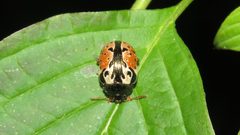
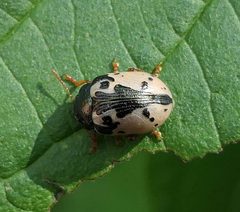
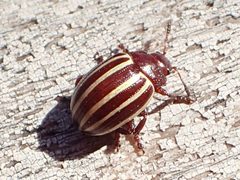
Calligrapha is a large of leaf beetles in the Chrysomelinae, comprising over 100 distributed throughout the Americas from North America through Central and South America. The genus is characterized by intricate, often script-like elytral markings that give the group its . Several species have significant economic importance: some are agricultural pests (notably C. exclamationis on sunflower crops), while others have been deployed as agents for weeds including Parthenium hysterophorus and Ambrosia artemisiifolia. The genus exhibits complex evolutionary phenomena including multiple independent origins of unisexual (female-only) species through hybridization, and intricate associations with endosymbionts. Taxonomic boundaries within Calligrapha remain imprecise, with ongoing systematic revisions clarifying species groups and subgeneric classifications.
Pronunciation
How to pronounce Calligrapha: /kælɪˈɡræfə/
These audio files are automatically generated. While they are not always 100% accurate, they are a good starting point.
Identification
Identification to level requires examination of elytral pattern configuration, particularly the arrangement and connectivity of spots, lunules, and bands. The shape of the end of the in the male genitalia provides a key diagnostic character for distinguishing major lineages and species groups. Species groups are characterized by specific pattern elements: for example, the C. argus group species possess a single spot enclosed by the humeral lunule and a complete arcuate band laterally confluent with the subsutural stripe (except in C. elegantula), combined with a deep hypomeral furrow and characteristic carving at the apex of the flagellum. The subgenus Erythrographa is distinguished by reddish testaceous coloration extending to dark body parts including elytral markings, two spots enclosed by the humeral lunule, and a bifid flagellum terminus.
Images
Distribution
Distributed throughout the Americas, with greatest diversity in Central and South America. The C. argus group is centered in the Caribbean Mesoamerican biogeographic domain, with C. ancoralis and C. diversa extending north to the California-Rocky Mountain domain, and C. argus, C. diversa, and C. simillima reaching south to the Caribbean Northwest-South American domain. The subgenus Erythrographa is to Central America and particularly diverse in the Mexican Transition Zone, ranging from southern Texas through Mexico to Panama.
Life Cycle
In C. pnirsa, emerge from sites in spring. are laid in masses on plant leaves. Larvae feed gregariously on foliage, passing through four instars. occurs in soil. The is , with a single per year. Adults overwinter in protected locations.
Behavior
Larvae of at least some exhibit gregarious feeding . of C. pnirsa and likely other species overwinter in protected locations. Adults of C. spiraeae discriminate among plant cultivars based on foliar chemistry, avoiding plants with high anthocyanin content.
Ecological Role
Herbivorous leaf-feeders on their plants. Some have been utilized as agents for weeds, including C. bicolorata introduced to India for Parthenium hysterophorus control, C. suturalis introduced to Russia for Ambrosia artemisiifolia control, and C. (Zygogramma) signatipennis with demonstrated potential for Tithonia tubaeformis management.
Human Relevance
Several are significant agricultural pests, particularly C. exclamationis on sunflower crops in North America. Conversely, multiple species have been intentionally introduced as agents for weeds. Some members of the subgenus Zygogramma are agricultural pests, while others serve as biocontrol agents.
Similar Taxa
- ZygogrammaHistorical taxonomic uncertainty; some Calligrapha were formerly classified in Zygogramma or vice versa, and the subgenus Zygogramma is recognized within Calligrapha. The distinction between these has been fluid and requires careful examination of genitalic and elytral characters.
Sources and further reading
- BugGuide
- Wikipedia
- GBIF taxonomy match
- iNaturalist taxon
- NCBI Taxonomy
- Catalogue of Life
- Systematic revision of the genus Calligrapha Chevrolat (Coleoptera: Chrysomelidae, Chrysomelinae) in Central America: The group of Calligrapha argus Stål
- NOTES ON THE HABITS AND LIFE HISTORY OF CALLIGRAPHA PNIRSA STAL (COLEOPTERA)
- Notes on the Life History and Ecology of Calligrapha spiraeae (Say) (Coleoptera: Chrysomelidae)
- Systematic revision of Central American Calligrapha Chevrolat of the subgenus Erythrographa subgen. nov. (Coleoptera: Chrysomelidae, Chrysomelinae)
- Systematic revision of Calligrapha Chevrolat (Coleoptera: Chrysomelidae) <br />with pale spots on dark elytra and description of two new species
- Comparative Studies of Development and Host Utilization by Calligrapha pantherina on Sida acuta and S rhombifolia
- Effects of New Cultivars of Ninebark on Feeding and Ovipositional Behavior of the Specialist Ninebark Beetle, Calligrapha spiraeae (Coleoptera: Chrysomelidae)
- Biology and Seasonal History of Calligrapha spiraeae (Say) (Coleoptera: Chrysomelidae), with Descriptions of the Immature Stages
- FOOD-PLANTS AND DISTRIBUTION OF THE SPECIES OFCALLIGRAPHAIN CANADA, WITH DESCRIPTIONS OF NEW SPECIES (COLEOPTERA, CHRYSOMELIDAE)
- New Distribution Records and Biogeography of <em>Calligrapha</em> Species (Leaf Beetles), in North America (Coleoptera: Chrysomelidae, Chrysomelinae)
- <i>Coreopsis Tinctoria</i>: An Unrecorded Host Plant of Adult <i>Calligrapha Callfornica Coreopsivora</i> (Coleoptera: Chrysomelidae)
- Assessment of the role of Wolbachia in mtDNA paraphyly and the evolution of unisexuality in Calligrapha (Coleoptera: Chrysomelidae)
- Testis‐specific RNA‐Seq of Calligrapha (Chrysomelidae) as a transcriptomic resource for male‐biased gene inquiry in Coleoptera
- Evolutionary significance of fixed chromosomal variants in South American populations of the leopard beetle Calligrapha polyspila (Coleoptera: Chrysomelinae)
- Calligrapha (Zygogramma) signatipennis (Stal, 1859) (Coleoptera: Chrysomelidae) and its Potential for Biological Control of Tithonia tubaeformis (Jacq.) Cass., 1825) (Asterales: Asteraceae)