
Zygogramma exclamationis
(Fabricius, 1798)
sunflower beetle
Zygogramma exclamationis, the sunflower , is a leaf-feeding chrysomelid beetle native to North America. emerge from hibernation in late spring to early summer, coinciding with sunflower seedling , and feed on young leaves. Larvae develop through summer, feeding nocturnally on foliage while hiding in flower bracts during daylight hours. The completes one per year, with new adults emerging in late summer before in soil. It is a recognized pest of cultivated sunflowers, particularly damaging to seedlings, and serves as for tachinid flies including Myiopharus neilli.
Pronunciation
How to pronounce Zygogramma exclamationis: //ˌzaɪɡoʊˈɡræmə ɛkskləˌmeɪʃəˈnaɪs//
These audio files are automatically generated. While they are not always 100% accurate, they are a good starting point.
Identification
resemble in size and striped pattern but can be distinguished by association with sunflowers and geographic range. The yellow-and-brown striped separate it from other sunflower-associated chrysomelids. Larvae are distinguished from other sunflower-feeding larvae by their yellowish coloration, humped profile, and daytime within flower bracts.
Images
Appearance
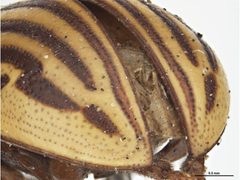
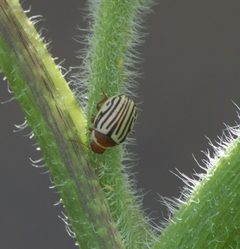
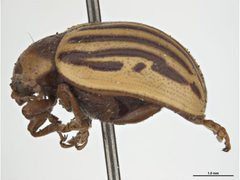
are approximately 6–12 mm in length and yellow with brown longitudinal stripes, resembling the Colorado potato beetle in general form. Larvae are yellowish with a humped profile.
Habitat
Cultivated sunflower fields and native sunflower (Helianthus) , particularly in the Great Plains region. Associated with early-season sunflower growth stages.
Distribution
North America: Great Plains region including Texas, North Dakota, Minnesota, and the Canadian provinces of Alberta, Manitoba, and Ontario.
Seasonality
active from late spring through late summer. Peak adult activity coincides with sunflower seedling in late spring to early summer. Larvae present during summer months. One per year; adults overwinter in soil.
Diet
Sunflower (Helianthus spp.) foliage. feed on young leaves of seedlings and mature plants. Larvae feed on younger leaves at night.
Host Associations
- Helianthus annuus - food plantcultivated and wild sunflower
- Myiopharus neilli - tachinid fly of
- Myiopharus macellus - tachinid fly of larvae
Life Cycle
One per year. emerge from soil hibernation in late spring to early summer, feed on sunflower foliage, and reproduce. Larvae develop through summer, feeding nocturnally while sheltering in flower bracts during daylight. occurs in soil in late summer; adults emerge, feed briefly, then return to soil to overwinter.
Behavior
feed diurnally on leaves. Larvae exhibit feeding , aggregating in small groups among flower bracts during daylight hours for shelter.
Ecological Role
Herbivore specializing on sunflowers; serves as for tachinid flies (Myiopharus spp.) that contribute to . In cultivated systems, functions as a pest that can reduce yield through defoliation.
Human Relevance
Agricultural pest of cultivated sunflowers. Economic damage occurs primarily to seedlings; action threshold is one per plant at seedling stage. Later growth stages tolerate higher larval densities (threshold: 15 larvae per plant with approximately 25% defoliation). Subject to monitoring and application when thresholds are exceeded.
Similar Taxa
- Leptinotarsa decemlineataColorado potato beetle shares similar yellow-and-brown striped pattern and body form, but occurs on Solanaceae rather than Asteraceae
- Zygogramma suturalisRagweed leaf beetle is congeneric and similarly patterned, but specialized on Ambrosia (ragweed) rather than Helianthus
- Calligrapha spp.Related chrysomelids with similar striped or spotted patterns, but distinguished by separated tarsal claws and often different plant
More Details
Parasitoid relationships
are parasitized by the tachinid fly Myiopharus neilli; larvae are parasitized by the related tachinid Myiopharus macellus. These contribute to of sunflower .
Sources and further reading
- BugGuide
- GBIF taxonomy match
- NCBI Taxonomy
- Managing Insect Pests of Texas Sunflowers - AgriLife Extension Entomology
- Bug Eric: More Insects From Sunflowers
- Zygogramma Desmogramma leaf beetles in Argentina | Beetles In The Bush
- Two Insects Lead the Fight Against Destructive Invasive Weed—But There's Still More to Be Done
- A new species of Myiopharus Brauer and Bergenstamm (Diptera: Tachinidae) parasitic on adults of the sunflower beetle, Zygogramma exclamationis (Fabricius)