
Chrysomela scripta
Fabricius, 1801
cottonwood leaf beetle
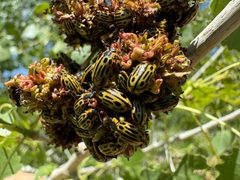
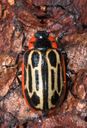
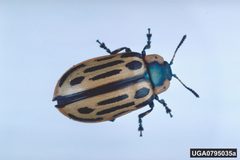
Chrysomela scripta, the cottonwood leaf beetle, is a leaf beetle in the Chrysomelidae that feeds on Populus , particularly cottonwoods and hybrid poplars. It is native to North and Central America and has been documented as a significant pest of poplar plantations. The species completes multiple per year in temperate regions, with development strongly influenced by temperature. It is subject to by and , and serves as to the microsporidian Nosema scripta.
Pronunciation
How to pronounce Chrysomela scripta: /krɪsoʊˈmiːlə ˈskrɪptə/
These audio files are automatically generated. While they are not always 100% accurate, they are a good starting point.
Identification
The can be distinguished from related Chrysomela by its association with Populus rather than Salix (willows). Within the , it may be confused with Chrysomela aeneicollis, which occurs in montane regions of California and feeds on Salix orestera; C. aeneicollis has been studied extensively in the Sierra Nevada and shows distinct genetic structure. Chrysomela scripta is specifically associated with cottonwoods and hybrid poplars (section Aigeiros), whereas C. lapponica in northern Europe feeds exclusively on willows. Accurate identification requires host plant confirmation, as morphological distinctions among Chrysomela species can be subtle.
Images
Habitat
Associated with Populus , particularly cottonwoods (Populus deltoides) and hybrid Aigeiros poplars (Populus × euramericana). Documented in poplar plantations, natural stands of eastern cottonwood, and tissue-cultured hybrid poplar subclones. suitability is determined by plant presence.
Distribution
Native to North America and Central America. Documented from southern Wisconsin, Tennessee, and throughout the range of its Populus . GBIF records indicate presence in Vermont, USA.
Seasonality
In southern Wisconsin, four occur between May and September, with maximal numbers and damage in the third generation. Development requires accumulation of above a minimal threshold of 10.8 °C.
Diet
Foliage of Populus , particularly cottonwoods and hybrid Aigeiros poplars (Populus × euramericana, Populus deltoides). Feeding is influenced by phenolic glycoside concentrations in leaves, with detectable variation in host selection based on clonal and leaf age.
Host Associations
- Populus deltoides - food planteastern cottonwood; primary native
- Populus × euramericana - food planthybrid Aigeiros poplar; significant plantation pest
- Nosema scripta - microsporidian infecting , , muscles, and other tissues
- Coleomegilla maculata - preyed upon bycoccinellid consuming up to 25% of
- Shizonatus latus - parasitized bypteromalid destroying up to 26% of pupae
Life Cycle
Four per year in southern Wisconsin (May–September). Minimal developmental threshold: 10.8 °C. Mean thermal requirement: 257 ± 26 per generation. : 510 ± 153 per female. stage not specified in available sources.
Behavior
and larvae defoliate plants and destroy growing tips. Host selection is mediated by plant secondary chemistry; beetles discriminate among host and leaf ages based on phenolic glycoside concentrations. Infected individuals show reduced feeding activity and fecal production.
Ecological Role
Herbivore and pest of native and plantation Populus. regulated by (Coleomegilla maculata) and (Shizonatus latus). Serves as for microsporidian Nosema scripta, which may reduce feeding rates in infected .
Human Relevance
Economic pest of hybrid poplar plantations and nursery stock. Defoliation can reduce growth and destroy dominance in cultivated trees. Subject to through agents.
Similar Taxa
- Chrysomela aeneicollisMontane California feeding on Salix orestera; studied for persistence and local in Sierra Nevada; distinguished by plant and geography
- Chrysomela lapponicaNorthern European feeding exclusively on willows (Salix); misidentification risk in regions where ranges might overlap, though C. lapponica does not occur in North America
- Chrysomela mainensisWillow-feeding ; distinguished by plant preference and geographic range
More Details
Thermal biology
Development is strongly temperature-dependent, with predictable times based on accumulation. This trait has been quantified for modeling in plantation management.
Chemical ecology
selection is mediated by phenolic glycosides, with measurable variation among host and leaf ages. This plant-herbivore chemical interaction has been studied for implications in resistance breeding.
Pathogen susceptibility
Susceptible to Nosema scripta microsporidian , which can be transmitted both horizontally and vertically. The related Colorado potato beetle (Leptinotarsa decemlineata) is also susceptible to this in laboratory cross- studies.
Sources and further reading
- BugGuide
- Wikipedia
- GBIF taxonomy match
- iNaturalist taxon
- NCBI Taxonomy
- Tracking a Montane Leaf Beetle | Bug Squad
- Who's Speaking at UC Davis Entomology Fall Seminars? | Bug Squad
- Beetle botanists | Beetles In The Bush
- North American turtles establish succcessful populations in Germany, possibly threathening ecosystems | Blog
- Harvestmen Use Glue to Capture Prey
- Arctics | Blog
- Nosema scripta N. Sp. (Microsporida: Nosematidae), A Microsporidian Parasite of the Cottonwood Leaf Beetle, Chrysomela scripta (Coleoptera: Chrysomelidae)1
- Clonal and Leaf Age Variation in Populus Phenolic Glycosides: Implications for Host Selection by Chrysomela scripta (Coleoptera: Chrysomelidae)
- THE BIOLOGY AND ECOLOGY OF THE COTTONWOOD LEAF BEETLE, CHRYSOMELA SCRIPTA (COLEOPTERA: CHRYSOMELIDAE), ON TISSUE CULTURED HYBRID AIGEIROS (POPULUS × EURAMERICANA) SUBCLONES IN WISCONSIN