
Odontota
Chevrolat in Dejean, 1836
locust leaf miners
Species Guides
7- Odontota arizonica
- Odontota dorsalis(locust leaf miner)
- Odontota floridana
- Odontota horni(soybean leafminer)
- Odontota mundula
- Odontota scapularis(orange-shouldered leaf miner)
- Odontota signaticollis
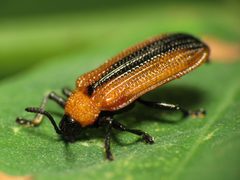
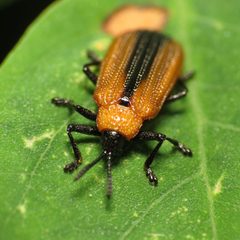
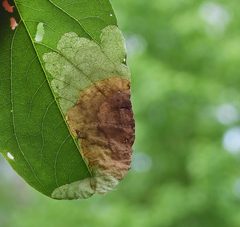
Odontota is a of leaf beetles in the Chrysomelidae, comprising approximately eight to nine described . The genus includes notable agricultural and forestry pests, particularly species that mine leaves of leguminous trees. The most well-known species, Odontota dorsalis (locust leaf miner), feeds on black locust (Robinia pseudoacacia) and related species, causing distinctive "scorched" foliage damage. Several species have been documented with specialized including extended copulation and post-copulatory mate guarding.
Pronunciation
How to pronounce Odontota: /oʊˈdɒn.toʊ.ta/
These audio files are automatically generated. While they are not always 100% accurate, they are a good starting point.
Identification
Members of Odontota are small leaf beetles with body forms typical of the Cassidinae (tortoise beetles and hispines). can be distinguished from other Chalepini by plant associations and subtle morphological characters; definitive identification often requires examination of genitalia. Odontota dorsalis is recognized by its association with locust trees and the distinctive mining damage it produces. The name Odontota (Greek: "toothed") references dental structures, though specific diagnostic features for genus-level identification are not well-documented in accessible sources.
Images
Habitat
in this are associated with woody legumes, particularly trees in the genus Robinia (locusts). and larvae inhabit the and leaf tissues of trees. occurs in ground litter beneath host trees.
Distribution
Eastern North America, with records from the United States including Colorado (fossil ), Arizona, Florida, and the eastern seaboard. Distribution corresponds closely with native and planted ranges of Robinia species.
Seasonality
emerge from sites in spring (May-June in temperate regions). Two occur annually in the northern part of the range, with second-generation adults appearing in mid-to-late summer. Activity ceases with onset of cold weather as adults return to ground-level overwintering sites.
Diet
Larvae feed as leaf miners, consuming mesophyll tissue between upper and lower leaf surfaces of plants. feed externally on leaves, producing small holes in young foliage and skeletonizing mature leaves.
Host Associations
- Robinia pseudoacacia - primary black locust
- Robinia - -level locust trees generally
Life Cycle
Complete with two annually in temperate regions. are deposited on lower leaf surfaces and covered with female , possibly as protection. Larvae mine within leaves, forming blotches that turn from white to brown as tissue dies. occurs within the mine; emerge to feed and reproduce. Adults overwinter in ground litter beneath trees.
Behavior
stridulate by rubbing wings against a rasp-like structure on the surface. Males exhibit extended copulation (mean 202 minutes, range 25-583 minutes) and post-copulatory "escort" , remaining with females for hours after mating while actively guarding against rival males and engaging in combat. This appears to function as mate guarding to prevent sperm competition. Larvae may use acoustic signals to locate adults within wood.
Ecological Role
Herbivore and on woody legumes. Contributes to nutrient cycling through leaf damage, though generally not lethal to established trees. Serves as prey for including larvae, lady beetles, and syrphid fly larvae.
Human Relevance
Several are minor forestry and ornamental pests. Odontota dorsalis causes conspicuous "scorched" foliage on black locust trees, reducing aesthetic value and potentially affecting growth of young trees. Odontota horni (soybean leafminer) is an agricultural pest of soybean. Black locust honey production may be indirectly affected by heavy .
Similar Taxa
- Other Cassidinae (tortoise beetles and hispines)Similar body form and leaf-feeding habits; distinguished by associations and subtle morphological characters
- Other leaf-mining beetles in ChrysomelidaeSimilar larval feeding mode; distinguished by specificity and mine
More Details
Taxonomic note
The Odontota belongs to the tribe Chalepini within Cassidinae. The group has been variously classified with tortoise beetles (Cassidinae sensu lato) and hispines (formerly recognized as separate subfamily Hispinae). Modern classification places both groups within an expanded Cassidinae.
Fossil record
Odontota americana is known from the Eocene Florissant Formation of Colorado (approximately 34 million years old), indicating long evolutionary history of the in North America.
Sources and further reading
- BugGuide
- Wikipedia
- GBIF taxonomy match
- iNaturalist taxon
- NCBI Taxonomy
- Catalogue of Life
- Scorched locust, courtesy of the Locust leafminer, Odontota dorsalis — Bug of the Week
- Scorched locust - Locust leafminer, Odontota dorsalis — Bug of the Week
- Recyclers in the Circle of Life: Bess beetles, Odontotaenius disjunctus — Bug of the Week
- Throwback Monday: Recyclers in the circle of life - Bess beetles, Odontotaenius disjunctus — Bug of the Week
- Passalidae | Beetles In The Bush
- Long copulations and post-copulatory ‘escort’ behaviour in the locust leaf miner,Odontota dorsalis(Coleoptera: Chrysomelidae)