
Odontota dorsalis
(Thunberg, 1805)
locust leaf miner, locust leafminer
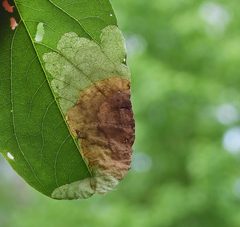
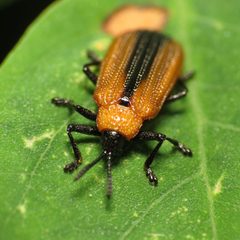
Odontota dorsalis, commonly known as the locust , is a leaf beetle in the Chrysomelidae. It is native to North America and feeds primarily on black locust (Robinia pseudoacacia) and related in the Fabaceae family. The is known for producing distinctive 'scorched' damage on trees, caused by both skeletonization and larval leaf mining. Two occur annually in most of its range.
Pronunciation
How to pronounce Odontota dorsalis: /oˈdɒn.toʊtə ˈdɔr.sə.lɪs/
These audio files are automatically generated. While they are not always 100% accurate, they are a good starting point.
Identification
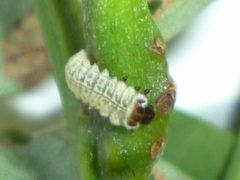
are small leaf beetles, typically dark in coloration. Larvae are not visible externally, as they mine within leaf tissue between upper and lower surfaces. The characteristic damage pattern distinguishes this : adults produce small holes in young leaves and skeletonized patches on mature foliage, while larvae create large whitish blotches that later turn brown, giving affected trees a scorched or burned appearance. This damage pattern on black locust trees is highly distinctive and generally sufficient for identification.
Images
Habitat
Associated with black locust (Robinia pseudoacacia) and related plants in the Fabaceae . overwinter in soil beneath host trees. Larvae develop within leaf tissue between upper and lower leaf surfaces. Found in eastern North American forests, along roadsides, and in ornamental plantings where host trees occur.
Distribution
North America. Recorded from Canada (Manitoba, New Brunswick, Ontario, Quebec) and the United States (Alabama, Arkansas, Connecticut, Delaware, District of Columbia, Florida, Georgia, Idaho, Illinois, Indiana, Kansas, Kentucky, Louisiana, Maine, Maryland, Massachusetts, Michigan, Minnesota, Mississippi, Missouri, Nebraska, New Hampshire, New Jersey, New York, North Carolina, Ohio, Oklahoma, Pennsylvania, Rhode Island, South Carolina, Tennessee, Virginia, West Virginia, Wisconsin).
Seasonality
Two per year in most of range. emerge from sites in spring (May-June), with first-generation adults appearing in mid-summer. Second generation occurs later in summer. Peak damage visible typically mid-July.
Diet
feed on leaves of black locust (Robinia pseudoacacia), Robinia hispida, and related Fabaceae including Sophora japonica, Acacia , Amorpha fruticosa, Arachis hypogaea, Falcata comosa, Cercis canadensis, Cladrastis lutea, Desmodium species, Pueraria lobata, Gleditsia triacanthos, Laburnum anagyroides, Phaseolus lunatus, Phaseolus vulgaris, and Glycine max. Feeding produces small holes in tender young leaves and skeletonization of mature leaves. Larvae mine soft tissue between leaf surfaces.
Host Associations
- Robinia pseudoacacia - primary black locust; primary
- Robinia hispida -
- Sophora japonica -
- Acacia spp. -
- Amorpha fruticosa -
- Arachis hypogaea - peanut
- Falcata comosa -
- Cercis canadensis - eastern redbud
- Cladrastis lutea - American yellowwood
- Desmodium spp. -
- Pueraria lobata - kudzu
- Gleditsia triacanthos - honey locust
- Laburnum anagyroides - golden chain tree
- Phaseolus lunatus - lima bean
- Phaseolus vulgaris - common bean
- Glycine max - soybean
Life Cycle
Two per year. overwinter in soil beneath trees. In spring (May-June), adults emerge and fly to treetops to feed on fresh young leaves. After feeding, females deposit small batches of on lower leaf surfaces, covering them with excrement (possibly as protection). Eggs hatch into larvae that tunnel into leaves and mine tissue between upper and lower surfaces. Larval development completes in approximately one week, after which occurs within the leaf. Adults of first generation emerge and repeat the cycle, with second generation occurring later in summer.
Behavior
are active flyers, moving from sites to treetops in spring. Females exhibit distinctive post-oviposition of defecating on masses, likely as a protective against . Larvae are endophagous, feeding internally within leaf tissue. Adults and larvae of second may feed on leaves already damaged by first generation. Mating behavior includes long copulations and post-copulatory 'escort' behavior where males remain with females after mating. Both adults and larvae produce sound; adults stridulate by rubbing wings against a rasp-like structure on the surface.
Ecological Role
Herbivore and on black locust and related leguminous trees. Despite conspicuous damage, black locust trees generally tolerate with little long-term harm due to the tree's hardiness. Serves as prey for including larvae, lady beetles, and flower fly larvae, though leaf mining lifestyle provides partial protection from surface-dwelling predators. Contributes to nutrient cycling through herbivory on nitrogen-fixing plants.
Human Relevance
Considered a pest of black locust in ornamental and forestry settings due to unsightly 'scorched' appearance of damaged foliage. However, damage is primarily aesthetic; black locust trees typically withstand repeated without significant mortality. tree valued for durable, rot- wood historically used for fence posts and rails, and as a nectar source for honey production. No significant economic impact on agricultural crops despite broad host range.
Similar Taxa
- Other Chrysomelidae leaf beetlesSuperficially similar in general body plan, but locust is distinguished by specificity to Robinia and related , and by characteristic leaf mining damage pattern not produced by external-feeding leaf beetles.
- Other leaf mining insects (Lepidoptera, Diptera, Hymenoptera)May produce similar blotch mines, but differ in plant association, mine , and presence of skeletonization damage. O. dorsalis damage on black locust is distinctive.
Sources and further reading
- BugGuide
- Wikipedia
- GBIF taxonomy match
- iNaturalist taxon
- NCBI Taxonomy
- Catalogue of Life
- Archive — Bug of the Week
- Scorched locust, courtesy of the Locust leafminer, Odontota dorsalis — Bug of the Week
- Scorched locust - Locust leafminer, Odontota dorsalis — Bug of the Week
- Recyclers in the Circle of Life: Bess beetles, Odontotaenius disjunctus — Bug of the Week
- Throwback Monday: Recyclers in the circle of life - Bess beetles, Odontotaenius disjunctus — Bug of the Week
- Passalidae | Beetles In The Bush
- Long copulations and post-copulatory ‘escort’ behaviour in the locust leaf miner,Odontota dorsalis(Coleoptera: Chrysomelidae)