
Caryedon serratus
(Olivier, 1790)
Groundnut Bruchid, Groundnut Borer
Caryedon serratus is a bruchid in the Chrysomelidae, commonly known as the groundnut bruchid or groundnut borer. It is a major pest of stored groundnuts (Arachis hypogaea) and also develops on seeds of wild legumes such as Piliostigma thonningii. The has a broad pantropical and subtropical distribution spanning Africa, the Americas, Europe, and Oceania. Its is strongly influenced by temperature and humidity, with development rates varying significantly across environmental conditions.
Pronunciation
How to pronounce Caryedon serratus: /ˈkærɪədɒn səˈreɪtəs/
These audio files are automatically generated. While they are not always 100% accurate, they are a good starting point.
Identification
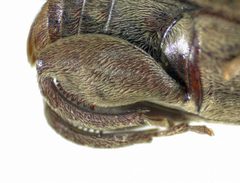
Distinguished from other stored-product bruchids by its association with groundnut pods and seeds rather than pulses or grains. can be separated from related bruchid by genitalic and external morphological characters typical of Caryedon. The ' broad range among Caesalpinioideae legumes and its pantropical distribution help differentiate it from more geographically restricted bruchid pests. Specific identification requires examination of male genitalia and comparison with reference specimens.
Images
Appearance
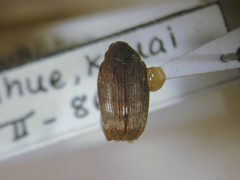
are small beetles with mean length of 4.10 mm and breadth of 3.40 mm. measure approximately 0.58 mm in length and 0.15 mm in breadth. Larvae () pass through four instars with mean lengths of 0.69, 1.27, 2.52, and 3.58 mm and breadths of 0.35, 0.86, 1.35, and 2.10 mm respectively. Pupae measure approximately 4.60 mm in length and 3.00 mm in breadth. The grub stage is the primary damaging form, feeding internally within seeds.
Habitat
Primarily associated with stored groundnut seeds and pods in agricultural settings. In natural environments, occurs in savanna where it develops on seeds of wild leguminous trees such as Piliostigma thonningii. Laboratory studies indicate optimal performance at temperatures of 30-35°C and relative humidity of 60-65%, though the tolerates a wider range of conditions.
Distribution
Pantropical and subtropical distribution including Africa, the Caribbean, Europe and Northern Asia (excluding China), Central America, North America, Oceania, and South America. Specific studied include the Gambia River region, Lamto savanna in Ivory Coast, Ganye area in Adamawa State Nigeria, and Akola region in India.
Seasonality
In West African savanna conditions, exhibits 2-3 per year with first generation developing on maturing seeds at the beginning of the dry season, and subsequent generations developing in dry seeds. enter a semi-lethargic state during the rainy season with no pupal . Under constant laboratory conditions of 25-30°C, continuous breeding occurs on stored groundnuts.
Diet
Specialized seed feeding on seeds of Fabaceae, Caesalpinioideae. Primary agricultural is groundnut (Arachis hypogaea). Natural hosts include Piliostigma thonningii and potentially other leguminous trees. Larvae feed internally within seeds, with the stage lasting approximately 14-33 days depending on temperature.
Host Associations
- Arachis hypogaea - primary agricultural Groundnut; main stored product causing economic damage
- Piliostigma thonningii - natural Wild Caesalpinioideae tree in West African savanna; seeds support 2-3 annually
Life Cycle
Complete with , larval (), pupal, and stages. Egg incubation: 3-7 days depending on temperature (3-4 days at 30°C/60% RH, 4-5 days at 35°C/65% RH, 6-7 days at 40°C/70% RH). Larval period: 14-23 days (19-23 days at 30°C/60% RH, 14-18 days at 35-40°C with 65-70% RH). Pupal period: approximately 13.5 days. Adult longevity: 12-13.5 days under laboratory conditions; total life period 48-76.5 days with females generally living longer than males. Total duration: 33-40 days at 30°C/60% RH, 14-18 days at 35°C/65% RH, and 16-20 days at 40°C/70% RH. Pre-oviposition period in females: approximately 1.5 days; oviposition period: approximately 5.5 days.
Behavior
Females deposit on or near seeds. Larvae bore into seeds and feed internally, completing development within a single seed. are capable of and disperse to new host patches. Under natural savanna conditions, adults enter a semi-lethargic state during the rainy season, resuming activity in the dry season. The has been observed to develop resistance to after approximately 10 years of exposure.
Ecological Role
Seed that reduces seed viability of legumes. In natural savanna , acts as a control agent for Piliostigma thonningii. Serves as host for a complex of including Uscana caryedoni ( parasitoid), Anisopteromalus caryedophagus, Bracon sp., Proconura serratocida, and Eurytoma caryedocida, contributing to local structure.
Human Relevance
Major pest of stored groundnuts causing significant post-harvest losses in tropical and subtropical regions. have been documented at transit crossings and storage facilities, particularly near the Gambia River. Management historically involved Lindane and Malathion, though resistance development has necessitated alternative approaches including phosphine under plastic sheeting. and extracts have been investigated as potential control agents. The ' response to various plants and botanical compounds has been studied to develop strategies.
Similar Taxa
- Callosobruchus spp.Other bruchid pests of stored legumes; distinguished by primary associations (pulses and grains vs. groundnuts) and geographic distribution patterns
- Acanthoscelides obtectusCommon bean bruchid with overlapping distribution; differs in specificity and morphological characters of and larvae
More Details
Temperature and Humidity Effects
Development rate and survival are strongly temperature-dependent. Optimal conditions for laboratory rearing are 30-35°C and 60-65% relative humidity. Higher temperatures (40°C) extend development but may shorten overall duration due to accelerated larval development. Extreme conditions reduce viability and .
Pesticide Resistance
Historical control efforts in The Gambia documented sequential resistance to Lindane and Malathion over approximately 10-year periods, necessitating to phosphine . This pattern illustrates the capacity for rapid to chemical control in stored-product environments.
Sources and further reading
- BugGuide
- Wikipedia
- GBIF taxonomy match
- iNaturalist taxon
- NCBI Taxonomy
- Biology of Groundnut Bruchid Caryedon Serratus (Olivier)
- Response of Caryedon serratus (Oliver) (Bruchidae: Coleoptera) towards Various Botanicals and Hosts
- Caryedon serratus and its parasitoids in the Savanna around Lamto, Ivory Coast
- A comparative study of some aspects of the reproduction of three Caryedon serratus strains in presence of its potential host plants
- Study on the biology of groundnut bruchid, Caryedon serratus Olivier [Coleoptera: Bruchidae] on stored groundnut in Ganye area, Adamawa State, Nigeria
- Egg-Laying Behaviour of Caryedon serratus (Olivier) on the Essential Oils of Skimmia anquetilia
- Effect of Temperature and Humidity on the Biology and Morphometric Measurement of Groundnut Bruchid (Caryedon serratus Olivier) [Coleoptera: Bruchidae] in Groundnut Seed