
Megabruchidius dorsalis
(Fåhraeus, 1839)
honey locust seed beetle, Asian seed beetle
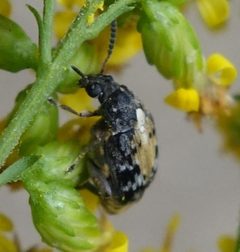
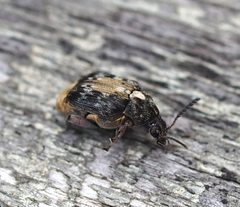
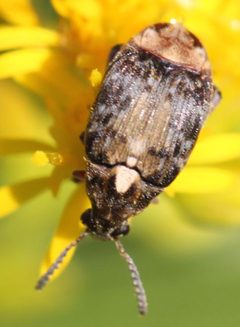
Megabruchidius dorsalis is an seed beetle (Chrysomelidae: Bruchinae) native to Asia that has established across Europe and North America. The is oligophagous on Caesalpinioideae seeds, primarily developing within pods of Gleditsia species. exhibit freeze-avoidant cold strategy with supercooling points around -10°C. The has demonstrated range expansion in its introduced range, colonizing North American Gymnocladus dioica in addition to its native Asian Gleditsia hosts.
Pronunciation
How to pronounce Megabruchidius dorsalis: /ˌme.ɡə.bruːˈkɪd.i.əs dɔːrˈseɪ.lɪs/
These audio files are automatically generated. While they are not always 100% accurate, they are a good starting point.
Identification
emerge from seed pods through characteristic exit holes. Identification relies on examination of antennal patterns and association with Gleditsia or Gymnocladus plants. Molecular identification may be required for definitive confirmation given similarity to other bruchine beetles.
Images
Habitat
Urban and suburban environments associated with ornamental Gleditsia triacanthos (honey locust) plantings. Found in areas where mature seed pods accumulate on ground or remain on trees. Established in parks, streetscapes, and managed landscapes across introduced range.
Distribution
Native to Asia (Oriental region). Introduced and established in Europe (first recorded Italy 1989; subsequently Slovenia, Croatia, Belgium, Ukraine, Eastern Black Sea region, and at least 15 European countries). North American records include association with introduced Gymnocladus dioica. GBIF records confirm presence in Belgium.
Seasonality
active during warmer months; from seed pods occurs when mature pods are available. strategy involves cold with supercooling point depression through cryoprotectant accumulation.
Diet
Obligate seed developing entirely within seeds of Caesalpinioideae (Fabaceae). Larvae consume endosperm and embryo tissues within seed coat.
Host Associations
- Gleditsia triacanthos - primary honey locust; most common in introduced European range
- Gleditsia fera - native recorded from Taiwan in native range
- Gymnocladus dioica - expanded Kentucky coffeetree; North American native colonized in introduced range
Life Cycle
Complete with development entirely within seed pods. deposited on or within pods. Larvae mine into seeds and feed internally, creating characteristic exit holes upon as . Multiple per year possible in favorable climates. adults demonstrate freeze-avoidant physiology with cryoprotectant accumulation (glycerol, lipid) and cryoprotective dehydration.
Behavior
use antennal and mouthpart to locate plants. Females deposit on lower leaf surfaces or within pods; egg-covering with excrement has been observed in related bruchine as anti- defense. Adults capable of long-term survival under cold stress through maintenance of supercooled state.
Ecological Role
Seed reducing reproductive output of plants. demonstrate enemy release hypothesis counterexample: Gymnocladus dioica experiences seed in introduced range where M. dorsalis is present, but lacks seed predators in its native North American range. Potential competitive interactions with native seed predators in invaded regions unknown.
Human Relevance
Pest of ornamental Gleditsia triacanthos in urban landscaping. Potential economic impact on honey locust seed production. Subject of research investigating -based management strategies. Model organism for studying insect cold and range expansion.
Similar Taxa
- Other Bruchinae seed beetlesSimilar and seed-feeding ; requires examination or molecular identification for differentiation
- Acanthoscelides obtectusCommon bean weevil with similar body plan; distinguished by association and antennal structure
More Details
Cold tolerance physiology
employ freeze-avoidant strategy with supercooling point of -10.62°C and lower lethal temperature of -19.48°C at 28°C acclimation. Cold acclimation at 15-25°C significantly depresses supercooling point and freezing point compared to control. Cryoprotectants include glycerol and lipids, with water content reduction under prolonged cold exposure.
Invasion history
First European record Italy 1989. Slovenia first recorded 2017 with subsequent establishment confirmation at 36 locations (97% pod rate). Rapid range expansion across Europe facilitated by widespread ornamental planting of Gleditsia triacanthos.
Host range plasticity
Strict oligophagy on Caesalpinioideae in native range (Gleditsia ). Demonstrated switch to phylogenetically related Gymnocladus dioica (Umtiza clade) in introduced Central European range, representing significant diet breadth expansion.
Sources and further reading
- BugGuide
- GBIF taxonomy match
- iNaturalist taxon
- NCBI Taxonomy
- Scorched locust, courtesy of the Locust leafminer, Odontota dorsalis — Bug of the Week
- Scorched locust - Locust leafminer, Odontota dorsalis — Bug of the Week
- Discovery of wasp species previously unknown in the U.S.
- Early Detection, Collaboration Key to Invasive Fruit Fly Eradication in Florida
- How One Entomologist Found Her Calling in Crop Protection
- Megabruchidius dorsalis (Fåhraeus). [Distribution map].
- Tujerodni invazivni hrošč semenar Megabruchidius dorsalis (Chrysomelidae) živi v Sloveniji The alien invasive seed beetle Megabruchidius dorsalis (Chrysomelidae) established in Slovenia
- Additional records of Megabruchidius dorsalis (Fåhræus, 1839) (Coleoptera, Chrysomelidae, Bruchinae) in Zagreb, Croatia
- Cold tolerance strategy and cryoprotectants of Megabruchidius dorsalis in different temperature and time stresses
- Ultrastructure of the Sensilla on the Antennae and Mouthparts of Bean Weevils, Megabruchidius dorsalis (Coleoptera: Bruchinae)
- First record of non-native Asian seed beetle, Megabruchidius dorsalis (Fåhræus, 1839) and its parasitoid, in Slovenia
- The Modern Distribution and Biological Features of the Bean Beetle, Megabruchidius dorsalis (Fåhraeus, 1839) (Coleoptera, Chrysomelidae, Bruchinae) in the Eastern Black Sea Region
- On the Biology of the East Asian Seed Beetle, Megabruchidius dorsalis (Coleoptera, Chrysomelidae, Bruchinae), an Adventive Species for Ukraine
- Host‐plant range expansion to Gymnocladus dioica by an introduced seed predatory beetle Megabruchidius dorsalis