
Megabruchidius
Borowiec, 1984
Species Guides
1- Megabruchidius dorsalis(honey locust seed beetle)
Megabruchidius is a of seed beetles in the Bruchinae (Chrysomelidae), established by Borowiec in 1984. The genus comprises Asian that have become in Europe, North America, South America, and South Africa. At least two species are well-documented: M. dorsalis and M. tonkineus, both specialized feeders on seeds of Gleditsia (honey locusts) and related Caesalpinioideae legumes. These beetles complete their entire larval development inside seeds, emerging as through exit holes. The genus has attracted significant research attention due to its economic impact as a pest of ornamental and forestry trees, its expanding range in introduced regions, and its potential use as a agent for invasive honey locust.
Pronunciation
How to pronounce Megabruchidius: /ˌmɛɡəˌbrʊˈkɪdiəs/
These audio files are automatically generated. While they are not always 100% accurate, they are a good starting point.
Identification
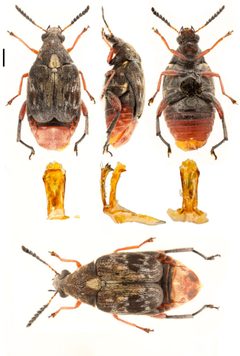
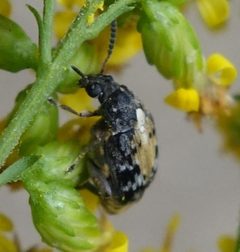
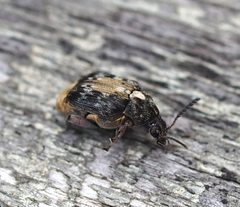
within Megabruchidius are distinguished from other bruchine by genitalic , particularly male aedeagal structure. M. dorsalis and M. tonkineus can be separated by subtle differences in body size, coloration, and genitalic characters; M. tonkineus tends to be slightly smaller with distinct pronotal and elytral patterns. Both species possess serrated with multiple types. Accurate identification typically requires dissection and examination of male genitalia or female bursa copulatrix; external morphology alone is unreliable for species-level determination.
Images
Habitat
Megabruchidius inhabit temperate to subtropical regions where plants occur. In native Asian ranges, they are associated with natural and cultivated stands of Gleditsia species. In introduced regions, they occupy urban parks, gardens, forest plantations, and naturalized of Gleditsia triacanthos and Gymnocladus dioicus. are found on or near host trees, particularly during the seed pod maturation period. The microhabitat centers on fallen or hanging seed pods, which serve as both food source and larval development site.
Distribution
Native to East and Southeast Asia (China, Vietnam, Taiwan, and adjacent regions). Introduced and established across Europe (first recorded Italy 1989, subsequently Bulgaria, France, Germany, Greece, Hungary, Russia, Serbia, Switzerland, Slovenia, Croatia, Ukraine), North America, South America (Argentina, Chile), and South Africa. Within Europe, spread has been rapid since the late 1980s, with M. dorsalis more widespread than M. tonkineus.
Seasonality
activity coincides with plant , particularly seed pod maturation and availability. In temperate introduced regions, adults are typically active from late summer through autumn when Gleditsia pods mature and fall. occurs as adults, with cold strategies including freeze avoidance through cryoprotectant accumulation (glycerol, lipids) and cryoprotective dehydration. Laboratory studies indicate larval development within seeds requires approximately 67 days.
Diet
Strictly seed-feeding; larvae develop entirely within seeds of Fabaceae Caesalpinioideae. Primary are Gleditsia (G. sinensis, G. triacanthos, G. australis, G. fera). In introduced ranges, M. dorsalis has expanded its host range to include Gymnocladus dioicus (Kentucky coffeetree), a related North American caesalpinioid legume. No feeding by on plant tissues has been documented; adult nutrition likely derives from nectar, pollen, or metabolic reserves.
Host Associations
- Gleditsia sinensis - primary (native range)Economically important in China
- Gleditsia triacanthos - primary (native and introduced ranges)Honey locust; major in Europe, North America, South Africa
- Gleditsia australis - recorded
- Gleditsia fera - recorded Taiwan record
- Gymnocladus dioicus - expanded range (introduced range only)Kentucky coffeetree; represents shift to Umtiza clade in Europe
Life Cycle
Complete with all larval stages spent inside a single seed. Females deposit on or near developing seed pods. Larvae bore into seeds, feeding on cotyledonary tissue, and pupate within the seed cavity. emerge through round exit holes, typically one per seed though up to three have been observed. Development time from oviposition to adult averages 66–67 days under laboratory conditions. Adults may undergo reproductive or ; occurs as adults with cold-hardiness mechanisms.
Behavior
utilize serrated with seven types and multiple subtypes for location and mate recognition. No in sensilla type, but quantitative differences exist: males possess more sensilla auricillica, while females have more sensilla trichoidea on maxillary palps. Adults are capable of long-distance , facilitating rapid range expansion. In South Africa, M. tonkineus damages approximately 9% of available seeds. Host-searching involves antennal and palp-mediated chemoreception.
Ecological Role
As seed , Megabruchidius function as natural enemies of Caesalpinioideae legumes. In native ranges, they likely regulate Gleditsia recruitment through seed mortality. In introduced ranges, they have been considered for of Gleditsia triacanthos in South Africa, though -specificity concerns exist given the observed host expansion to Gymnocladus dioicus in Europe. The supports including Eupelmidae (Eupelmus confusus, E. urozonus) and Pteromalidae (Cyrtoptyx lichtensteini, Dinarmus acutus).
Human Relevance
Significant economic pest of ornamental and forestry Gleditsia plantings, causing seed yield reduction and reducing reproductive output of trees. In China, M. dorsalis is described as causing severe yield reduction in Gleditsia . In Europe and North America, damage to ornamental honey locusts affects seed production for horticulture. Potential value as agent for Gleditsia triacanthos, though host-range expansion to native and ornamental legumes poses risks. Research interest in -based control methods based on ultrastructure studies.
Similar Taxa
- BruchidiusSympatric congeneric in Bruchinae; B. coreanus co-occurs with M. dorsalis on Gleditsia sinensis in China, distinguished by different genitalic and typically smaller body size
- AcanthoscelidesAnother bruchine with seed-feeding larvae; distinguished by antennal structure, male genitalia, and typically different associations (often Phaseolinae rather than Caesalpinioideae)
More Details
Cold tolerance physiology
M. dorsalis are freeze-avoidant, maintaining body fluids in a supercooled state. Supercooling point at 28°C is -10.62°C; low lethal temperature is -19.48°C. Cold acclimation at 15–25°C significantly lowers supercooling point and increases lipid and glycerol content compared to control (28°C) conditions. Long-term low-temperature induction (0°C) reduces water content, indicating cryoprotective dehydration as a complementary strategy.
Sensory morphology
possess seven types with eight subtypes: Böhm bristles, two trichoid subtypes, two chaetica subtypes, four basiconic subtypes, cavity, auricillica, and gemmiform sensilla. Mouthparts bear five additional sensilla types on maxillary and labial palps. ST1 trichoid sensilla are most abundant in both sexes.
Invasive spread dynamics
First European record: Italy 1989. Slovenia: 2017. Croatia: multiple locations by 2022. Present in 15+ European countries. Climate modeling indicates suitable may increase 4.8% under future climate scenarios in Guizhou Province, China, with eastward range shift predicted. Isothermality, minimum temperature of coldest month, and precipitation variance are key distribution-limiting variables.
Sources and further reading
- BugGuide
- GBIF taxonomy match
- iNaturalist taxon
- NCBI Taxonomy
- Megabruchidius dorsalis (Fåhraeus). [Distribution map].
- Megabruchidius tonkineus . [Distribution map].
- Megabruchidius tonkineus (Pic). [Distribution map].
- Tujerodni invazivni hrošč semenar Megabruchidius dorsalis (Chrysomelidae) živi v Sloveniji The alien invasive seed beetle Megabruchidius dorsalis (Chrysomelidae) established in Slovenia
- Additional records of Megabruchidius dorsalis (Fåhræus, 1839) (Coleoptera, Chrysomelidae, Bruchinae) in Zagreb, Croatia
- First record of non-native Asian seed beetle, Megabruchidius dorsalis (Fåhræus, 1839) and its parasitoid, in Slovenia
- Distribution and impact of the Asian seed beetle, Megabruchidius tonkineus (Pic, 1904) (Coleoptera: Chrysomelidae: Bruchinae) on Gleditsia triacanthos L. seeds in South Africa
- New record of seed beetles of the genus Megabruchidius Borowiec, 1984 (Chrysomelidae: Bruchinae) and associated parasitoids (Hymenoptera: Chalcidoidea) from Bulgaria
- The Modern Distribution and Biological Features of the Bean Beetle, Megabruchidius dorsalis (Fåhraeus, 1839) (Coleoptera, Chrysomelidae, Bruchinae) in the Eastern Black Sea Region
- On the Biology of the East Asian Seed Beetle, Megabruchidius dorsalis (Coleoptera, Chrysomelidae, Bruchinae), an Adventive Species for Ukraine
- Cold tolerance strategy and cryoprotectants of Megabruchidius dorsalis in different temperature and time stresses
- Ultrastructure of the Sensilla on the Antennae and Mouthparts of Bean Weevils, Megabruchidius dorsalis (Coleoptera: Bruchinae)
- Host‐plant range expansion to Gymnocladus dioica by an introduced seed predatory beetle Megabruchidius dorsalis
- Maximum Entropy Model Prediction of the Distributions of Two Sympatric Bean Weevil Species, Megabruchidius dorsalis (Fahraeus, 1839) and Bruchidius coreanus (Chûjô, 1937), under Various Climate Scenarios in Guizhou Province, China