
Elateropsis
Chevrolat, 1862
Species Guides
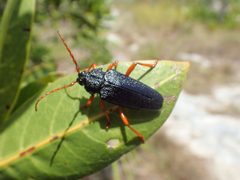
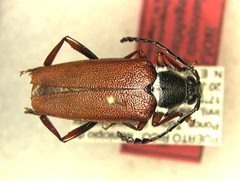
1Elateropsis is a of longhorn beetles (Cerambycidae) in the Prioninae, tribe Solenopterini. The genus was established by Chevrolat in 1862 and contains approximately 22 described distributed primarily in the Caribbean region and parts of Central and South America. Species in this genus are characterized by their robust, cylindrical bodies and relatively large size typical of prionine cerambycids. The genus includes several island endemics, such as species restricted to the Bahamas, Cayman Islands, and Cuba.
Pronunciation
How to pronounce Elateropsis: /ɛˌlætəˈræpsɪs/
These audio files are automatically generated. While they are not always 100% accurate, they are a good starting point.
Identification
Members of Elateropsis can be distinguished from related prionine by their elongate, somewhat flattened body form and that are typically shorter than the body length in females and approximately equal to body length in males. The genus is placed in tribe Solenopterini, which is characterized by specific features of the and pronotal structure. -level identification requires examination of antennal proportions, elytral coloration patterns, and male genitalia; several species exhibit distinctive dark and light color banding on the .
Images
Habitat
of Elateropsis are associated with tropical and subtropical forest environments, particularly in coastal and island . They are typically found in hardwood forests where their larval occur. The shows a strong association with Caribbean island , with multiple species to specific island groups.
Distribution
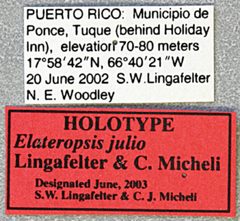
The is distributed across the Caribbean Basin, including the Bahamas, Cayman Islands, Cuba, Jamaica, Hispaniola, and Puerto Rico. Several occur in Central America and northern South America. The highest appears to be in the Greater Antilles, particularly Cuba.
Host Associations
- hardwood trees - larval As with other Prioninae, larvae are presumed to develop in wood of living or dead hardwood trees, though specific records for most Elateropsis are not documented.
Ecological Role
As wood-boring beetles, larvae of Elateropsis contribute to nutrient cycling in forest through the decomposition of wood. Their tunneling activities may also create for other organisms in dead and dying trees.
Similar Taxa
- DerobrachusBoth are large prionine with robust bodies, but Derobrachus has extremely long (often twice body length in males) and is primarily distributed in North and Central America rather than the Caribbean.
- MallodonSimilar in general form and also in Solenopterini, but Mallodon typically have more strongly toothed and different antennal proportions; Mallodon is more broadly distributed in the Neotropics.
More Details
Taxonomic history
The has been revised several times, with major contributions by Galileo & Martins (1994) who described numerous new , and Lingafelter (2015) who added additional species and clarified relationships within the genus.
Conservation status
Many Elateropsis have restricted ranges on single islands or island groups, making them potentially vulnerable to loss and climate change, though formal conservation assessments are lacking for most species.