
Solenopterini
Genus Guides
2Solenopterini is a tribe of longhorn beetles within the Prioninae. Members are characterized by robust, often large-bodied forms adapted to wood-boring . The tribe includes several distributed primarily in the Neotropical region, with some representation in the Nearctic. Solenopterini are associated with dead or decaying hardwoods and are of occasional economic significance as timber pests.
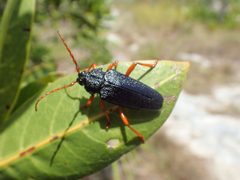
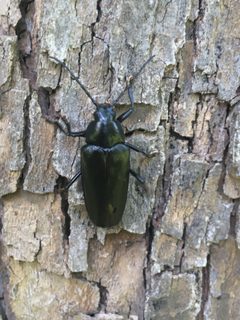
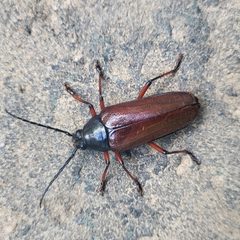
Pronunciation
How to pronounce Solenopterini: //ˌsoʊ.lɛˌnɒptəˈraɪnaɪ//
These audio files are automatically generated. While they are not always 100% accurate, they are a good starting point.
Identification
Solenopterini can be distinguished from other Prioninae tribes by the combination of: pronotum with distinct lateral or spines; often with raised or tubercles; usually serrate or pectinate in males, sometimes sexually dimorphic; frequently enlarged and projecting, especially in males. The overall body form tends to be more cylindrical and heavily sclerotized compared to the flattened or elongate forms seen in Macrotomini or Callipogonini.
Images
Habitat
Associated with forested environments, particularly mature or hardwood forests. Larvae develop in dead or decaying wood of broadleaf trees; often found on or near material.
Distribution
Primarily Neotropical, with extension into the southern Nearctic. Documented from Mexico through Central America and into South America, with greatest diversity in tropical regions.
Diet
Larvae feed on dead or decaying hardwood (xylophagy). Specific plant records are limited for many ; may feed on sap, bark, or take little nourishment.
Life Cycle
Complete with wood-boring larvae. Larval development occurs within wood, with duration likely extending multiple years in most . occurs in galleries; emerge through exit holes. Specific timing and duration vary by species and are poorly documented for many .
Behavior
are primarily and attracted to light. Males may be territorial around breeding sites; enlarged in males suggest intraspecific combat or mate-guarding functions, though direct observations are limited. Larvae are cryptic, feeding internally in wood.
Ecological Role
Primary decomposers of dead hardwood , contributing to nutrient cycling and carbon release in forest . Creation of larval galleries provides for other (, ). May accelerate wood decay and influence forest patterns.
Human Relevance
Some occasionally damage seasoned timber or structural wood, though economic impact is generally minor compared to other wood-boring beetles. of certain species are collected for the insect trade due to large size and distinctive . Limited use as bioindicators of forest health or mature forest conditions.
Similar Taxa
- MacrotominiAlso large Prioninae with robust bodies, but Macrotomini typically have more flattened body profiles, reduced pronotal armature, and males lack the pronounced mandibular enlargement common in Solenopterini.
- CallipogoniniShare large size and wood-boring habits, but Callipogonini often have more elongate relative to body and different pronotal sculpturing; mandibular dimorphism is less pronounced or absent.
- PrioniniOverlap in general , but Prionini usually possess more strongly toothed or laminate and different elytral patterns; geographic distributions also differ with Prionini more broadly distributed in Palearctic and Oriental regions.
More Details
Taxonomic History
Solenopterini has undergone periodic revision, with some transferred to or from related tribes. The tribal limits remain under study, and molecular may further refine generic composition.
Conservation Status
No comprehensive assessments exist for the tribe as a whole. Individual may be threatened by loss in regions with extensive deforestation, particularly those dependent on mature forest conditions and specific trees.