
Mallodon
Lacordaire, 1830
hardwood stump borer
Species Guides
1- Mallodon dasystomus(hardwood stump borer)
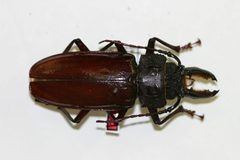
Mallodon is a of prionine longhorned beetles in the Cerambycidae. The genus contains approximately eight described distributed across the Americas, with M. dasystomus being the most widely studied and geographically extensive. Species in this genus are characterized by large body size, prominent , and association with hardwood . The genus was established by Lacordaire in 1830.

Pronunciation
How to pronounce Mallodon: /ˈmæloʊˌdɒn/
These audio files are automatically generated. While they are not always 100% accurate, they are a good starting point.
Images
Habitat
Hardwood forests; larvae develop in wood of various hardwood trees including oak, sweetgum, sugarberry, and hackberry. have been observed in wet bottomland forests and riparian corridors.
Distribution
occurs from the southern United States through Mexico and Central America to northern South America. Individual have more restricted ranges; M. dasystomus is the most broadly distributed, occurring across the southern tier of the U.S. and southward.
Host Associations
- oak - larval Quercus ; larval development in wood
- sweetgum - larval Liquidambar styraciflua
- sugarberry - larval Celtis laevigata
- hackberry - larval Celtis
- sycamore - larval Platanus ; M. dasystomus specifically associated with Platanus occidentalis and P. wrightii
Life Cycle
Larval development occurs within hardwood , with larvae boring into wood of living or partially dead trees. emerge from host material. Specific developmental timing varies by and region.
Behavior
are attracted to ultraviolet light. Males of M. dasystomus are attracted to volatile released by females. Both sexes respond to -derived volatile and prefer host material over non-host material. Males preferentially select host material containing live females.
Ecological Role
Wood-boring in hardwood forest ; contributes to decomposition of dead and dying wood and nutrient cycling in forest systems.
Human Relevance
Occasional pest of hardwood timber; sometimes encountered at lights. One specimen was documented arriving in Canada via commercial wood shipment from Mississippi.
Similar Taxa
- PrionusBoth are large prionine cerambycids with robust bodies and prominent ; Mallodon generally have more extensively hairy mouthparts and different antennal structure
- ParandraBoth belong to archaic cerambycid lineages with unusual ; Parandra have short, equal-segmented and more flattened, parallel-sided bodies with entire
More Details
Nomenclatural note
The specific epithet of M. dasystomus was consistently misspelled as 'dasytomus' in much of the literature until corrected. The proper spelling derives from Greek dasus (hairy) and stoma (mouth), referring to the hairy mouthparts characteristic of the .
Research significance
M. dasystomus has been studied for its chemical , specifically the role of volatile in location and mate finding. This makes it one of the better understood prionine beetles in terms of behavioral ecology.
Sources and further reading
- BugGuide
- Wikipedia
- GBIF taxonomy match
- iNaturalist taxon
- NCBI Taxonomy
- Catalogue of Life
- One-shot Wednesday: Mallodon dasystomus | Beetles In The Bush
- Not quite adult | Beetles In The Bush
- When is a stag beetle not a stag beetle? | Beetles In The Bush
- Miridae | Beetles In The Bush
- Role of Volatile Semiochemicals in the Host and Mate Location Behavior of Mallodon dasystomus (Coleoptera: Cerambycidae)