
Prionus cuneatus
Casey, 1924
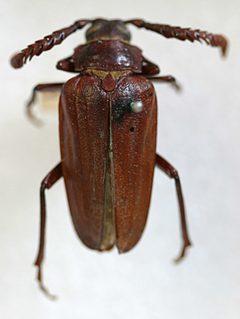
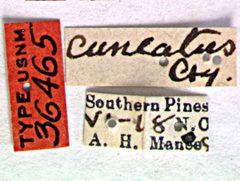
Prionus cuneatus is a of longhorned beetle in the Cerambycidae, Prioninae. The species was described by Casey in 1924 and is currently considered a synonym of Prionus imbricornis in some taxonomic databases. Like other members of the Prionus, it is a root-boring with subterranean larvae. The species belongs to a genus that has been the focus of recent collecting efforts in the Great Plains using synthetic prionic acid lures.
Pronunciation
How to pronounce Prionus cuneatus: //ˈpraɪ.ən.əs kuːˈniː.eɪ.təs//
These audio files are automatically generated. While they are not always 100% accurate, they are a good starting point.
Images
Distribution
North America; records indicate presence in California (CA) and Dominican Republic (DO), though the latter may represent data entry errors or introduced . The is associated with the broader distribution of Prionus imbricornis, which occurs in eastern North America.
More Details
Taxonomic Status
GBIF lists Prionus cuneatus as a synonym of Prionus imbricornis (Linnaeus, 1767), a well-known eastern North American commonly called the tile-horned prionus. The original description by Casey (1924) may have represented a regional variant or misidentification of P. imbricornis, which is highly variable in size and antennal .
Pheromone Research Context
in the Prionus, including those related to P. cuneatus/P. imbricornis, have been extensively studied for their use of prionic acid as a female component. This compound has been synthesized for commercial lures used in orchard pest management and ecological research, enabling detection of otherwise rarely encountered species.
Sources and further reading
- BugGuide
- GBIF taxonomy match
- iNaturalist taxon
- Threebanded Grasshopper
- How to catch “bucket loads” of Prionus fissicornis! | Beetles In The Bush
- My first experience with Prionus lure | Beetles In The Bush
- Just how widespread is Prionus heroicus? | Beetles In The Bush
- 2014 Great Plains Collecting Trip iReport | Beetles In The Bush