
Pidonia gnathoides
(LeConte, 1873)
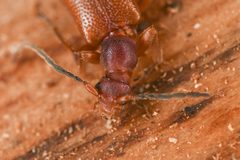
Pidonia gnathoides is a of longhorn beetle in the Cerambycidae, described by John Lawrence LeConte in 1873. It belongs to the Lepturinae, a group commonly known as flower longhorns. The species is documented from western North America, with records from British Columbia and the western United States. Field observations indicate visit flowers of various plant species, particularly in early season conditions.
Pronunciation
How to pronounce Pidonia gnathoides: /pɪˈdoʊniə næˈθɔɪdiːz/
These audio files are automatically generated. While they are not always 100% accurate, they are a good starting point.
Identification
Small black and yellow lepturine longhorn beetle. The specific epithet "gnathoides" (resembling jaws) may refer to distinctive mandibular or capsule features useful for separation from . Distinguished from similar Pidonia by color pattern and presumably antennal and pronotal proportions, though precise diagnostic characters require examination. The black and yellow coloration is characteristic of many Pidonia species, necessitating careful comparison with regional congeners such as Pidonia scripta and related .
Images
Habitat
Associated with montane and foothill environments in western North America. Observed in ponderosa pine forest and adjacent juniper/pinyon/oak woodland transition zones. collected from flowers in areas with mixed coniferous and deciduous vegetation, often at moderate elevations (~7000 ft).
Distribution
Western North America. Documented from British Columbia, Canada and the western United States including Arizona and Utah. GBIF records indicate presence in Canada (CA) and United States (US).
Seasonality
active in early season, with observations in June. Field notes describe activity during "early season" conditions with moderate temperatures and abundant moisture, suggesting peak activity in late spring to early summer.
Behavior
visit flowers, where they have been observed on Hymenopappus filifolius (fine-leaved hymenopappus), Sphaeralcea ambigua (desert globemallow), and other blooming vegetation. Flower-visiting is characteristic of the Lepturinae. activity on tree trunks has not been documented for this specifically.
Ecological Role
flower-visiting suggests potential role in pollination, though this has not been quantified. Larval unknown; related Lepturinae typically develop in decaying wood or fungal substrates.
Similar Taxa
- Pidonia scriptaSimilar black and yellow color pattern in the same ; requires examination of antennal proportions and pronotal shape for separation.
- Other Lepturinae genera (e.g., Anthophylax, Analeptura)Small size and flower-visiting overlap; distinguished by antennal insertion, pronotal structure, and elytral pattern.
More Details
Taxonomic Note
Catalogue of Life lists this as a synonym under the Thesalia, while GBIF and iNaturalist maintain it as accepted under Pidonia. This reflects ongoing taxonomic uncertainty regarding subgeneric classification within Pidonia.