
Gaurotes cyanipennis
(Say, 1824)
Gaurotes cyanipennis is a of longhorn beetle in the Cerambycidae, described by Thomas Say in 1824. It belongs to the Lepturinae and tribe Rhagiini. The species is found in eastern North America, with records from Canada and the United States. Like other members of its , it exhibits metallic coloration typical of many rhagiine beetles.
Pronunciation
How to pronounce Gaurotes cyanipennis: /ɡɔːˈroʊtiːz ˌsaɪəˈnɪpɛnɪs/
These audio files are automatically generated. While they are not always 100% accurate, they are a good starting point.
Identification
Distinguished from other Gaurotes by the combination of uniformly blue or blue-green without prominent spots or bands, and eastern North American distribution. Separated from similar Lepturinae such as Brachyta and Acmaeops by the more uniformly colored, less patterned elytra and overall body proportions. Differs from Gaurotes thoracica, which has more contrasting pronotal coloration and different geographic range.
Images
Appearance
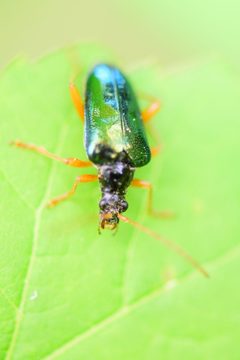
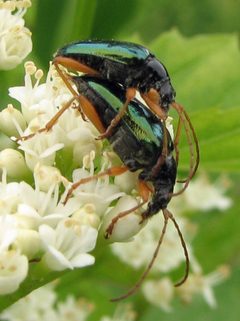
have metallic blue or blue-green , with the specific epithet 'cyanipennis' referring to the blue coloration of the wing covers. Body form is elongated and somewhat flattened, typical of Lepturinae. are moderately long, not exceeding body length. and pronotum often contrast in color with the elytra, frequently appearing darker or with coppery tones.
Habitat
Deciduous and mixed forests, particularly associated with hardwood trees. are frequently found on flowers and foliage. Larval development occurs in dead or decaying hardwood, typical of the tribe Rhagiini.
Distribution
Eastern North America. Documented from Canadian provinces including New Brunswick, Ontario, and Québec. Range extends southward into the northeastern and north-central United States.
Seasonality
are active from late spring through summer, with peak activity typically in June and July. Activity period corresponds with flowering of trees and associated vegetation.
Host Associations
- hardwood trees - larval developmentlarvae develop in dead or decaying wood
Life Cycle
Complete with , larva, pupa, and stages. Larvae are wood-borers in dead hardwood. Adults emerge in late spring and are relatively short-lived, focusing on and .
Behavior
are and frequently observed visiting flowers, where they feed on pollen and nectar. They are capable fliers and readily move between trees. When disturbed, adults may drop from vegetation or fly to escape.
Ecological Role
Larvae contribute to wood decomposition and nutrient cycling in forest by processing dead hardwood. serve as when visiting flowers. The functions as a secondary colonizer of dead wood, following initial fungal and insect degradation.
Human Relevance
No significant economic impact. Occasionally encountered by entomologists and naturalists. Not a pest of living trees or timber products.
Similar Taxa
- Gaurotes thoracicaSimilar body form and metallic coloration, but has more contrasting dark pronotum with distinct color pattern and primarily western distribution
- Brachyta spp.Similar Lepturinae with elongated bodies, but typically have spotted or banded rather than uniform blue coloration
- Acmaeops spp.Related rhagiine beetles with similar , but generally smaller with different antennal proportions and elytral
More Details
Taxonomic history
Originally described by Thomas Say in 1824, a foundational figure in American entomology. The has remained in the Gaurotes throughout its taxonomic history, though placement has been refined with Lepturinae.