
Trigonarthris subpubescens
(Kirby, 1837)
Minnesota Long-horned Beetle
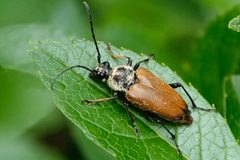
Trigonarthris subpubescens is a flower longhorn beetle ( Lepturinae) native to North America. The is recorded from Manitoba, New Brunswick, Nova Scotia, and Ontario in Canada, with observations also documented in the United States. As a member of the Lepturini tribe, are and associated with flowers. The species has been documented in mesic forest and is one of several Trigonarthris species that appear to be rare or localized in distribution.
Pronunciation
How to pronounce Trigonarthris subpubescens: //trɪɡəˈnɑːrθrɪs sʌbpuˈbɛsɛnz//
These audio files are automatically generated. While they are not always 100% accurate, they are a good starting point.
Images
Habitat
Mesic forests with eastern deciduous tree including American beech (Fagus grandifolia), tulip poplar (Liriodendron tulipifera), and cucumbertree (Magnolia acuminata). Associated with hackberry/soapberry woodland canyons and riparian deciduous woodlands in the Great Plains transition zone.
Distribution
Canada: Manitoba, New Brunswick, Nova Scotia, Ontario. United States: recorded from Oklahoma (northwestern), Missouri (southeastern at Trail of Tears State Park), and likely broader eastern North American range based on related patterns.
Seasonality
activity in July based on trapping records from Oklahoma and Missouri.
Behavior
are . As a lepturine flower longhorn, adults are attracted to and feed on flowers.
Ecological Role
flower-feeding suggests potential role in pollination, though this has not been quantified.
Similar Taxa
- Trigonarthris minnesotanaBoth are rare Trigonarthris documented at Trail of Tears State Park, Missouri; T. minnesotana is similarly associated with unique mesic forest in the region.
- Trigonarthris atrataAnother uncommon Trigonarthris captured in traps in northwestern Oklahoma; both species appear to be localized in distribution and associated with specific woodland .
- Typocerus velutinusSimilar flower longhorn with which T. deceptus (a related rare ) is easily confused; members of Lepturinae share general body plan of moderately robust build with pubescent patterns.