
Trigonarthris
Haldeman, 1847
flower longhorn beetles
Species Guides
3- Trigonarthris atrata(flower longhorn)
- Trigonarthris proxima(Proximal Long-horned Beetle)
- Trigonarthris subpubescens(Minnesota Long-horned Beetle)
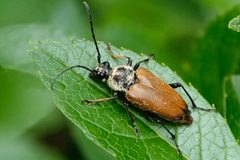
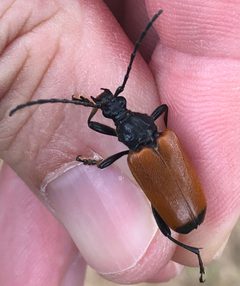
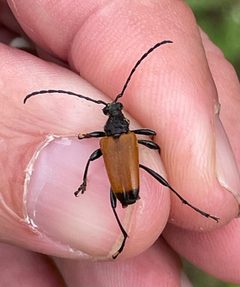
Trigonarthris is a of flower longhorn beetles (Cerambycidae: Lepturinae) established by Haldeman in 1847. The name derives from Greek 'trigonon' (triangle) and 'arthron' (joint), referring to a triangular joint structure. The genus contains three recognized : T. atrata, T. minnesotana, and T. proxima. Members are flower visitors, though individual species remain poorly documented biologically.
Pronunciation
How to pronounce Trigonarthris: //ˌtraɪɡoʊˈnɑrθrɪs//
These audio files are automatically generated. While they are not always 100% accurate, they are a good starting point.
Identification
The is characterized by a triangular joint structure referenced in its etymology. -level identification requires examination of specific morphological features; T. minnesotana has been documented from mesic forest in association with eastern deciduous tree species. Specific diagnostic characters for distinguishing Trigonarthris from other Lepturini genera are not detailed in available sources.
Images
Habitat
T. minnesotana has been documented in mesic forest supporting eastern tree including American beech (Fagus grandifolia), tulip poplar (Liriodendron tulipifera), and cucumbertree (Magnolia acuminata). T. atrata has been captured in canyon riparian deciduous woodland in shortgrass prairie regions. Specific larval associations remain unknown for all species.
Distribution
Documented from the eastern and central United States. T. minnesotana recorded from Missouri and presumably Minnesota based on the specific epithet. T. atrata recorded from Oklahoma and likely broader Great Plains region. T. proxima described from eastern North America (Say, 1824). GBIF records indicate distribution in Vermont and broader US.
Seasonality
activity in mid-summer: T. atrata captured in late July in Oklahoma; T. minnesotana observed in July in Missouri. Specific data for other and regions not available.
Diet
feed on flower nectar and pollen. T. minnesotana has been observed on flowers of wild hydrangea (Hydrangea arborescens) in the company of other lepturine flower longhorns.
Host Associations
- Hydrangea arborescens - flower T. minnesotana observed feeding on flowers
- Fagus grandifolia - associationmesic forest where T. minnesotana occurs
- Liriodendron tulipifera - associationmesic forest where T. minnesotana occurs
- Magnolia acuminata - associationmesic forest where T. minnesotana occurs; possible larval unknown
Life Cycle
Larval and developmental stages remain completely unknown for all . Larval plants have not been identified.
Behavior
are and active on flowers. Attracted to ethanol and wine-based baits in jug traps, though not commonly captured in large numbers.
Ecological Role
function as when visiting flowers. Larval ecological role unknown due to undetermined associations.
Similar Taxa
- TypocerusBoth belong to Lepturini and share flower-visiting ; Trigonarthris distinguished by triangular joint structure referenced in etymology
- Other Lepturinae generaFlower longhorn beetles share activity and flower-feeding habits; specific structural differences in joint separate Trigonarthris
More Details
Etymology
The generic name combines Greek 'trigonon' (τρίγωνον, triangle) and 'arthron' (ἄρθρον, joint), referring to a triangular joint structure characteristic of the .
Species list
Three recognized: Trigonarthris atrata (LeConte, 1850), Trigonarthris minnesotana (Casey, 1913), and Trigonarthris proxima (Say, 1824).
Rarity status
T. minnesotana considered rare in collections and infrequently encountered; T. atrata described as 'very uncommon' in Oklahoma trapping studies.